Thursday, May 18, 2006

The Two Ways

Matthew 7:13-29
"Enter by the narrow gate, since the road that leads to destruction is wide and spacious, and many take it; but it is a narrow gate and a hard road that leads to life, and only a few find it.
"Beware of false prophets who come to you disguised as sheep but underneath are ravenous wolves. You will be able to tell them by their fruits. Can people pick grapes from thorns, or figs from thistles? In the same way, a sound tree produces good fruit but a rotten tree bad fruit. A sound tree cannot bear bad fruit, nor a rotten tree bear good fruit. Any tree that does not produce good fruit is cut down and thrown on the fire. I repeat, you will be able to tell them by their fruits.
"It is not anyone who says to Me, 'Lord, Lord," who will enter the Kingdom of Heaven, but the person who does the will of My Father in heaven. When the day comes many will say to Me, 'Lord, Lord, did we not prophesy in Your name, drive out demons in Your name, work many miracles in Your name?' Then I shall tell them to their faces: I have never known you; 'away from Me, all evil doers!'
"Therefore, everyone who listens to these words of Mine and acts on them will be like a sensible man who built his house on rock. Rain came down, floods rose, gales blew and hurled themselves against that house, and it did not fall: it was founded on rock. But everyone who listens to these words of Mine and does not act on them will be like a stupid man who built his house on sand. Rain came down, floods rose, gales blew and struck that house, and it fell; and what a fall it had!"

Jesus had now finished what He wanted to say, and His teaching made a deep impression on the people because He taught them with authority, unlike their own scribes.
Jesus compares the Spiritual Life to a journey, where we come to a fork in the road. To the left is a huge, 4-lane, paved freeway, well maintained and well lit. A very safe road. To the right, on the other hand, is a narrow, pot-hole-ridden, gravelly, bumpy, hard road. And on this journey, Jesus tells us that we must take that hard road. The world tries to tell us that all roads lead to God, but Jesus plainly tells us that these two diverging paths (and, ultimately, there are only two) go in opposite directions. The wide, safe, paved freeway leads to Destruction, while the narrow, difficult road leads to everlasting Life.

Why is it that the hard road is the right road? Why is it that God didn't make it hard to go to Hell, and easy to go to Heaven?

All living creature grow and change. To cease to grow is to die. This is true with our spiritual life as well. The hardships that come in following Christ and being obedient to His commands help us to grow. Without them, we would never be challenged or stretched, but we would become complacent, static, and we would die. Through the harships, the hard choices and hard actions, we rise to the challenge. Our faith, courage and strength are tested, and through God's Grace, we overcome and grow more and more like Christ--and that's what it is all about!

But this attitude is insanity to the world. Our world desires the easy route. It desires to live in peace and luxury, not to struggle. Like electrons, we desire to take the path of least resistance. And the world, therefore, tries to dissuade us from taking the hard road. It beckons us to follow the easy road to hell. It constantly tries to undermine the truth of Christ and His Church. Things like The Gospel of Judas or The Da Vinci Code tell us that the Church has lied to us about the Gospel. People tell us that we don't need to follow God--that it's futile and meaningless. They tell us we are our own gods. But these things are all lies, and dangerous lies, designed to lead us astray. And if we are not careful and discerning, if we are not staying close to the Truth, we can be led astray. The False Prophets, Jesus says, are like wolves dressed up in sheep's clothing. They sound clever, they sound reasonable, many times they even sound Christian. But their lies are exposed in their lives. If their message does not bring us to a closer relationship with Jesus Christ, or to a greater willingness to obey His Will, then it is false. If their message claims to bring us closer to Christ without the necessity of keeping His commands, it is false. If their message appears to lead to righteousness without Christ, it is false.

Jesus said, it is not everyone who says, "Lord, Lord," that comes into His Kingdom. We need also to do what God wants us to do. Note that many of these false prophets will even claim miraculous signs as their proof! We can't be fooled! God's will is not to do miracles (though they may often accompany those who do His will). God's will, rather, is "only this, to do what is right, to love loyalty and to walk humbly with your God" (Micah 6:8).

If we do not do the Will of God, we won't be accepted into His Kingdom. Jesus finishes with the parable of the wise and foolish builders--the wise one who builds upon the solid foundation, and his house stands against all adversity, and the foolish one who builds on sand, and his house crumbles right away. It is not enough to hear the word, Jesus says, but we must act on it.

I'll conclude with a poem that I wrote when I was 16, reflecting on a girl I knew who gave up the Christian life for peer pressure, getting into drugs and other sinful behaviour. She left the narrow road, for the wide freeway. If we walk away, know that God always calls us back, asking us to turn around and regain the Narrow Way.
Holes in His Soles
(C)1996 Gregory Watson

Sweet girl, on a journey,
Growin' up, you're in a hurry.
Seek new things to get you by,
Always new, you want to fly!

Sweet girl, the road you're takin',
It looks all right, but you're mistaken.
Might look brilliant, might look bold,
But "all that glitters isn't gold."

Sweet girl, you missed the exit,
Go back a way, see if you can find it.
Careful though, wolves hide the gate,
They dress like sheep, don't take the bait.

"'Because narrow is the gate...
And there are few who find it.'
Wolves in sheep's clothing
Are trying to hide it."

So girl, take my hand,
I'll lead you back, to find the Man
Who built the gate and now protects it.
He guides us home, and will keep the way lit.

Sweet girl, look at His footprints.
See the holes in the middle of those imprints?
Listen now, I will tell how and why.
You see, He got those marks for you and I.

This Man's Dad so much loved us
He sent His Son to make a way for us.
So He came and worked from early 'til late,
And when He'd finished, there stood a gate.

One post up, one post across
It stands, a landmark to those who are lost.
The wolves, the fearsome stalkers of night,
They hated the Man, and His gate of light.

They killed Him in their hate.
Nailed His hands and feet to the gate.
All night the wolves howled and taunted,
Fear not though, this is what He wanted.

He died, and all was dark.
Those wolves, they ceased to bark.
But the Builder, dead He didn't stay!
He lived again on the third day!

The wolves ran in a defeated state.
With His blood, He christened the gate.
"It is finished!" the Son exclaimed
From Calvary, what the gate is named.

So that, sweet girl, is why
His feet are marked: for you and I.
His footprints guide us over rock and sand,
Down the road to the Promised Land.

So when the wolves come to cajole,
Follow the tracks with the hole in the sole.
This Man will keep the wolves at bay.
Follow Him close; He'll not lead you astray.

And now, sweet girl, I say adieu.
I must go and help others just like you.
They seek new things to get them by,
Always new, wanting to fly!

"'Because narrow is the gate...
And there are few who find it.'
Wolves in sheep's clothing
Are trying to hide it."

Follow close the prints with the hole.
Keep with the Guide; He'll heal your soul.
Follow the tracks over rock and sand,
One day you'll come to the Promised Land.
This concludes our study of Jesus' Sermon on the Mount.

God bless!

Labels: , , , , , ,

Sunday, April 30, 2006

The Way of the Cross

Updated! Here at last is the full article on The 5th Annual Good Friday Way of the Cross! With pictures!

Company of AngelsI'm thinking of naming St. Francis of Assisi as Company of Angels' Patron Saint. In our first performance, the Christmas Pageant, we told the story of how St. Francis originated Christmas Pageants. Now, doing some research, I found out that his monastic order, the Fransiscans, also originated the Stations of the Cross!

Originally, way back in the day, serious sins, when they were confessed, were atoned for through the Penance of making a pilgrimage to the Church of the Holy Sepulchre. In Jerusalem. On foot. Uphill both ways. Okay, maybe not the last one, but yeah, Penitents were required to walk to the Empty Tomb. In so doing, when they arrived in Jerusalem, they walked the Via Dolorosa, the Way of the Cross, reflecting on Jesus' Passion and death, until they reached the Empty Tomb. When the Muslims came on the scene and started making violence on the Christian world, this Penitential Walk was no longer a sure or safe thing for Christians. That, incidentally, is why the Crusades happened--they were, initially, defensive wars against Muslim aggressors. Unfortunately, greed and corruption took over later on, but in the first place, the Crusaders were the body-guards of the penitents on their way to the Tomb. Stick that in your Revisionist History Pipe and smoke it!

Francis, who originally was a Crusader, though he never made it to the front lines, got sick, went home, had a true conversion and began to preach the Gospel to all people, and his followers decided that it was not fair for the weak and the infirm and, well, anyone, to be made to risk life and limb to earn God's forgiveness. Yeah, it was a great idea when the Church was confined to the Mediterranean, and there weren't hostile forces cutting the pilgrims down! But times had changed, and so must the Church's practices.

So they developed what we now know as The Stations of the Cross--initially in a Church named for, and designed for, the Church of the Holy Sepulchre in Jerusalem, with 14 plain crosses labelled for their stations. As the practice became more common, every church put up these stations, often with depictions of what the scene related, and now, some 700-800 years later, it's one of the most distinctively Catholic things that we do!

The Good Friday Way of the Cross
Crowd: Photo from The Oakville Beaver, April 19, 2006, p.10That brings us to today (or at least to 5 years ago). When Pope John Paul II was coming to Toronto, the different Catholic Churches in Oakville decided to prepare for World Youth Day by, among other things, performing the Stations of the Cross on the streets of Oakville as a public proclamation of their faith. This was such an inspiring, and incredibly cool, thing, that they've continued it to this day. And so, this past April 14th, 2006, on a cold and rainy Good Friday morning, over 100 people gathered to walk the 8 km journey in honour of the Ultimate Sacrifice, Jesus Christ.

The following is the text of the Good Friday Way of the Cross pamphlet, with the devotional meditations, along with photos of the scenes.

All responses are bold.

Everyone Carried the Cross!: Photo by Alex LuyckxStations of the Cross
We come together to remember the final steps in the life of Jesus Christ, our Saviour. Jesus saved each one of us, and as we approach each Station of the Cross, let us reflect on our own personal Cross, the Cross each one of us is invited to carry in our daily lives.

+In the Name of the Father, and of the Son, and of the Holy Spirit. Amen.

1st Station - Jesus is Condemned to Death
Jesus Is Condemned: Photo by Alex LuyckxThough Pontius Pilate is unjust toward Jesus, he is the lawful governor and has power over Jesus. The Son of God is obedient. Yet obedience costs Jesus His life. For us to be obedient costs much less, yet how hard it is for us to obey.

How quick we are to condemn those in our own lives--our family, our friends, our classmates, those we work with. When we condemn those around us, we turn away from Jesus, turning the light of hope to darkness. In many countries, people are persecuted for expressing their faith publicly. Yet how many times do we deny our religion or condemn those who do not share our views?

Father, give us the courage to hear You speaking to us and to obey Your Word as Your Son did on our behalf. Let us pray for those who are persecuted for their beliefs. We also pray for the imprisoned and those who feel the chains of restraint emotionally and physically. Help us, Lord, to share the light of hope with our neighbours and friends who suffer emotional or physical abuse.

We pray to the Lord.
Lord, hear our prayer.
Jesus, remember me, when You come into Your Kingdom.

2nd Station - Jesus Carries His Cross

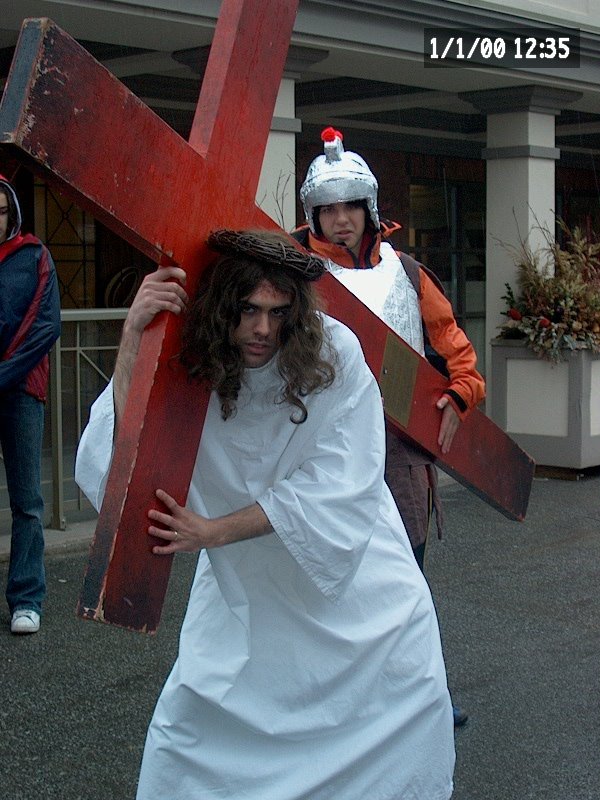
Jesus Carries His Cross: Photo by Melissa WatsonJesus, You struggle under the weight of the wooden Cross. You are forced to carry it through the streets while being mocked, laughed at, ridiculed.

Some of your friends even deny knowing You. How painful that must be for You, Jesus.

We experience many Crosses in our lives: fears, worries, frustrations. Many of us carry our Crosses every single day--they weigh us down, they handicap us, they prevent us from being able to care for others and love unconditionally. Yet we are strengthened with the knowledge that Jesus promises to be near us at all times. And so, as He carries His Cross, let us carry ours, knowing that Jesus once again is beside us, helping us to carry it.

Let us pray for those who are carrying their Cross--for those who continue to carry their Cross alone. May God bless and grace those who buckle under the weight of their failures and personal challenges.

We pray to the Lord.
Lord, hear our prayer.
Jesus, remember me, when You come into Your Kingdom.

3nd Station - Jesus Falls the First Time

Jesus Falls 1: Photo by Melissa WatsonSo many people around You, Jesus, yet You carry Your Cross alone. The same people that worshipped You with palms now spit at You in the streets. Struggling under the weight of the Cross, You fall to Your knees. Was there something in Your path that caused You to stumble? Did someone place something in Your way?

When we really stop to think about it, we place obstacles in Your path almost every day. Maybe it is the way that we have of keeping our faith hidden except for Sundays. If no one knows we are Christians, they won't expect anything special of us. No wonder You stumbled.

Forgive us, Lord, for the obstacles we place in Your path. How many times have we fallen on the journey? Every day we struggle under the weight of life's challenges.

Let us pray for those who have fallen in their lives. For those who struggle with addictions to drugs, alcohol, gambling, or other things; that we may lift them up each time they fall. Through our prayers and tangible actions, may we be there for them, and help them seek the help they need to walk again.

We pray to the Lord.
Lord, hear our prayer.
Jesus, remember me, when You come into Your Kingdom.

4th Station - Jesus Meets His Mother

Jesus Meets His Mother: Photo by Alex LuyckxThere is nothing more horrible than a mother seeing her child suffer and die. That's why it is so hard to understand how a mother could sacrifice her baby. But that is what happens each day in our world. Millions of babies die each year because they are inconvenient, they may be defective, or it's a way out of a difficult situation.

Lord Jesus, Your Mother shared Your sufferings. How helpless she must have felt.

Lord, we know how difficult it is for married couples, for unwed women, who struggle with a decision about an unwanted pregnancy. Yet we pray that our community will have the courage to embrace their struggle and support them in their time of need. We also give thanks for our mothers and grandmothers, our fathers and grandfathers--the gift of parents who guide us in our faith and welcome new members lovingly into their family.

Let us pray for all those who choose life, for mothers and fathers, and all those who will act as guardians of faith, hope, and love throughout our lives.

We pray to the Lord.
Lord, hear our prayer.
Jesus, remember me, when You come into Your Kingdom.

5th Station - Jesus Is Helped by Simon

Simon Helps Jesus: Photo by Melissa WatsonTravelling from Cyrene, Simon is pressed into service to help carry Your Cross. This is not a job that he asked for, or an honour that he sought. How often do we consider helping others an honour? Not very often. Most of the time we think of it as an inconvenience, something to be tolerated. Do I consider it and 'honour' to help a friend who is into drugs? To speak Christ's love to a homeless, begging teen in Toronto?

Help us, Lord, to reach out to serve the poor and suffering among us. Just as Simon helped You, Jesus, we ask Your grace to respond to those we can help, not just as a special favour to them, but as a way of life each and every day.

We pray for all those who are homeless, those who travel the streets alone with no one to love or care for them. May we serve as beacons of hope to those in need physically, emotionally and spiritually.

We pray to the Lord.
Lord, hear our prayer.
Jesus, remember me, when You come into Your Kingdom.

6th Station - Veronica Wipes the Face of Jesus

Veronica Meets Jesus: Photo by Melissa WatsonTradition tells us that through this act of kindness, Veronica was blessed to receive Your image imprinted on the cloth that she used to wipe Your brow.

When we reach out to another person in pain we are blessed with Your image also. If we look deep enough into the eyes of the young man with AIDS, we see Your face. If we listen to the girl struggling with drug addiction, it is Your voice we hear. Yet, at times, it is easier to pretend that those people are not our problem. Their disease is not something we caused. Why should we be concerned with them? Forgive us, Lord, for being cold and self-righteous.

Lord, help us see the tears in the eyes of our friends and then help to wipe them away. Each one of us knows someone close who is suffering or who has lost a loved one. May we take the time today to let those close to us know how important they are in our lives, wiping their tears with a kind word, a loving touch, a comforting embrace.

We pray for all those who are sick. May the healing hand of God ease their pain and bring them comfort knowing that God is watching over them, now and always.

We pray to the Lord.
Lord, hear our prayer.
Jesus, remember me, when You come into Your Kingdom.

7th Station - Jesus Falls a Second Time

Jesus Falls 2: Photo by Melissa WatsonJesus, You know what it is to struggle and fall. Because of Your suffering You know how hard it is to get up and try again. That's why every time we make a mistake You understand and You forgive us so easily. You only ask that we continue to try.

Are we models of Christ in our homes, schools, workplaces, and families? Through our actions, oftentimes we fail at living our faith each day. Whether it be comments to those who are different than us or by being indifferent to injustice taking place around us, we seem to forget our faith and fall once again. Yet, even when we fall time and again, You are there offering forgiveness if we are willing to accept it. You fell a second time, Jesus. Give us the grace to pick ourselves up and continue on.

Let us pray for the times when we have failed to be models of Christ in our community. For our personal struggles--may we rise up from the fall and continue on the path, seeking forgiveness and learning from our mistakes.

We pray to the Lord.
Lord, hear our prayer.
Jesus, remember me, when You come into Your Kingdom.

8th Station - Jesus Speaks to Some Women

Jesus Meets the Women: Photo by Melissa WatsonYou seem to speak rather harshly to the women of Jerusalem that day. You tell them to weep for themselves and their sins. You know that mankind has much to be sorrowful for. You wish them to recognise their own pilgrimage rather than weep for Yours.
Woman of Jerusalem: Photo by Alex Luyckx
Jesus, we should be weeping for our sins today. We don't seem to hesitate to exploit this world You have given us, with no regard for the future. What happens when this world has no more to give? We should be weeping for the future that our selfishness and greed are creating for the generations yet to come.

Our world is struggling. Peace at times seems so far away and hatred among nations ever present.

We pray for peace in the world. Just as Jesus spoke with the women, may nations come together to speak the language of peace and hope. We pray for all those who have died due to war and violence--their loss reminds each of us that we should always strive for peace. Peace will come one day because we trust in You, Lord Jesus.

We pray to the Lord.
Lord, hear our prayer.
Jesus, remember me, when You come into Your Kingdom.

9th Station - Jesus Falls a Third Time

Jesus Falls 3: Photo by Alex LuyckxOvercome with exhaustion, You collapse a third time on Your way to Calvary. And a third time You pull Yourself to Your feet and move on. Why don't You refuse to go any farther? Make Your tormenters carry You to the place of Your death! Why are You so cooperative?

In the face of pain and death, You continue to move forward. You refuse to give up. What happens to people when they become so overwhelmed they decide to take their own lives? How do they arrive at that point? What could possibly be so hopeless that the only avenue of escape is death?

Young people go through so many difficult times--trying to fit in, relationships, lack of self-esteem. As a community, we need to support each other and let our friends know that they are never alone--that we will continue to help them up even when they fall.

Let us pray for thos whose lives have been lost to suicide. For those who struggle with stress, those who find no answers to the daily questions that torment them. May God watch over them and help them know the light of hope and peace that He offers them because He loves them so much.

We pray to the Lord.
Lord, hear our prayer.
Jesus, Remember me, when You come into Your Kingdom.

10th Station - Jesus is Stripped of His Garments

Jesus is Stripped: Photo by Alex LuyckxLord Jesus, when You finally reach the place of Your death, Your tormenters are not even satisfied with the humiliation You have already suffered. They take Your clothes and roll dice for them, Your last earthly possessions. They leave You without an ounce of dignity.

Today we continue to add to Your sorrow by not acknowledging the dignity of people. There are those who sell their bodies, others who live on the street. We sometimes even forget the elderly among us, forgetting them or ignoring their cry for companionship. How little effort it would take, if we all worked together to make these lives a little brighter.

We pray for those who have been stripped of their garments physically, emotionally, and mentally. For those in our midst who have been abandoned, who have known no love, who return home each day feeling so incredibly alone. May we give them the gift of dignity and respect, remembering that we are each frail in our own way.

We pray to the Lord.
Lord, hear our prayer.
Jesus, Remember me, when You come into Your Kingdom.

11th Station - Jesus is Nailed to the Cross

Jesus is Nailed to the Cross: Photo by Alex LuyckxYou cry out, Jesus, as the nails pierce Your flesh. Why are they doing this to You? Is it because You love too much? Is it because You care for others? No, You suffer this way because we care too little. We attach too many strings to our love.

We too persecute people. Their only crime is complaining because they are hungry or cold. Why do we fail to reach out to them? Why do we not hear their cries for help? When we ignore their cries we drive the spikes a little deeper into Your flesh.

We pray for the times when our words have pierced the flesh of those around us. When we fail to look at others through the eyes of Christ, for times when we frive the nail deeper by hurtful words and actions. May we treat others with kindness and care, now and always.

We pray to the Lord.
Lord, hear our prayer.
Jesus, Remember me, when You come into Your Kingdom.

12th Station - Jesus Dies on the Cross

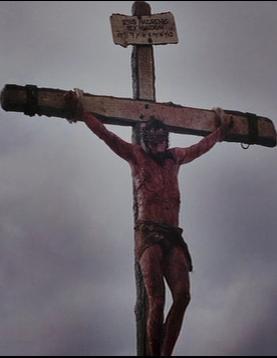
Jesus Dies: Photo by Alex LuyckxThere aren't many there for You when You die. Most of Your followers have gone into hiding because they are afraid. How alone You must feel.

There are thousands daily who die alone in the streets of Calcutta and in Africa. Many are children. We have such surplus today that these suffering people, the least of Your people, do not have to die in want. We forget they exist; we forget they go to bed hungry.

Let us pray for the children of the world, that they will be cared for as children of God. We pray that young people everywhere be given the opportunity to have their voice heard, to share their gifts and talents with the community and to weave the thread of faith through their daily actions.

We pray to the Lord.
Lord, hear our prayer.
Jesus, Remember me, when You come into Your Kingdom.

13th Station - Jesus is Taken Down From the Cross

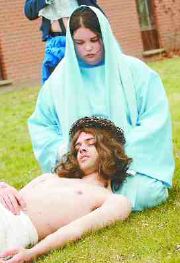
Jesus is Taken off the Cross: Photo from The Oakville Beaver, April 19, 2006, p.10The worst is over for You, Lord Jesus, but the pain has only begun for those who receive Your body from the Cross. Mary, like so many mothers today, receives into her arms the dead body of the Child she bore, fed, clothed, washed, listened to, loved. Help us not to turn our eyes from the tears of the mothers whose children are dying in our streets.

It is never easy to lose a loved one, no matter what the age or circumstance. It is our prayer and belief that these people have moved on to eternal life. We offer comfort to each other and find peace through our faith.

Let us pray for all those who have died, for friends and family who remain behind and mourn their loss. May we be present to those who grieve and offer them our prayers, our hearts, and our hands.

We pray to the Lord.
Lord, hear our prayer.
Jesus, Remember me, when You come into Your Kingdom.

14th Station - Jesus is Laid in the Tomb

Jesus is Laid in the Tomb: Photo from The Oakville Beaver, April 19, 2006, p.10Joseph of Arimathea needed to see that You had a decent burial place so he donated his tomb. Not satisfied with doing the minimum, he went to Pilate for permission to bury You. He could have left the details to someone else, but he risked the rejection of his peers and took care of it himself.

So often we are content to do the minimum that is expected. We grudgingly spend one hour at Mass and complain if it is one minute longer. We drop our few coins in hte basket and claim to be doing our fair share. Don't ask us to give our time, too! We tolerate those people who are a little different; don't ask us to love them.

Jesus, You gave Your life; You died a humiliating death, without a word of protest, even though You were innocent. All around us people suffer and we fail to reach out in love to those who are closest to us. Lord, help us to walk our way of the Cross with more faithfulness. You said that in order to follow You we must pick up our Cross daily. Help us to recognise our Crosses, because in accepting them, we imitate Your life. In imitating You we will eventually share in the Resurrection.

We pray for all of us gathered here today. May we live a faith that shows itself through action; may we be messengers of the Good News as we continue our personal journey. May we find strength, guidance, peace and support from our faith and from each other.

We pray to the Lord.
Lord, hear our prayer.
Jesus, remember me, when You come into Your Kingdom.


We pray to the Lord
Lord, hear our prayer.
Jesus, Remember me, when You come into Your Kingdom.

Have a Joyful Easter Season!
Stand and be Counted: Photo by Alex Luyckx

Acknowledgements: Thanks to The Oakville Beaver, Alex Luyckx, and my wife, Melissa Watson, for taking the photos used above. Hover your curser over the pics to see which are from whom.

God bless!

Labels: , ,

Tuesday, April 11, 2006

The Message of the Cross

Yesterday was my second anniversary as a Catholic! This is what it's all about!

Holy Week began on Sunday with Palm Sunday, or Passion Sunday, and the reading of the narrative of Christ's Passion (from Mark's Gospel). And so we enter the greatest week of the year, culminating in the greatest Feast of the Year!

This is what our faith is built around: The Cross of Christ. His death for us shows us His great love for us as it redeems us from our sins and forgives us! Through that wonderful Cross, we have been made sons and daughters of God! The Cross is the source of joy!

Let that sink in. Jesus' suffering and death saves us from our sin. So often, I think, we treat Good Friday as a terrible day as we hasten on to the "happy ending" of Easter Sunday. I was reminded of this fact last Sunday when a small boy asked Fr. Watters, "Why do we call Good Friday 'good' if that's when Jesus died?" Fr. Watters wisely responded, "Because it's the best day of the year!"

Truly, it is! If there were no Good Friday, there could be no Easter Sunday. If there were no Good Friday, we all would still be dead in our sins. If there were no Good Friday, we would not know of God's incredible love for us! And yet, Good Friday honours and remembers the most painful, tragic event that has ever occured--and we indeed call it "Good."

That is why St. Paul wrote, "The message of the cross is folly to those who are on the way to ruin, but for those of us who are on the road to salvation it is the power of God" (1 Corinthians 1:18). A few verses later, he says, "I was resolved that the only knowledge I would have while I was with you was knowledge of Jesus, and of Him as the crucified Christ." Jesus Himself told us that His glory was in the Cross! In fact, it was the Cross that would draw all people to Him. In John's Gospel, Jesus says, "'Now sentence is being passed on this world; now the prince of this world is to be driven out. And when I am lifted up from the earth, I shall draw all people to Myself'" (12:31-32). John comments on this saying, "By these words He indicated the kind of death He would die" (v. 33).

For Jesus, the Cross was His Glory, His Power. When St. John had his vision, in Revelation, he sees Jesus as "a Lamb standing that seemed to have been sacrificed" (Rev. 5:6), and to this Lamb, all the choirs of Heaven bow down and sing
You are worthy...
because You were sacrificed, and with Your blood
You bought people for God
of every race, language, people and nation
and made them a line of kings and priests for God,
to rule the world
(Rev. 6:9,10).
In the Crucifixion is joy; in the Crucifixion is victory; in the Crucifixion is redemption. This is why, in every Church, there is a Crucifix--to remind us of the Love and of the Victory in the Cross. "...You have had a clear picture of Jesus Christ crucified, right in front of your eyes..." (Galatians 3:1).
Many years ago in New York, a Gang was passing by St. Patrick's Cathedral. The gang members each dared each other to mock religion and the Church by going into the Cathedral and making a mock confession. One of the guys took the dare, and entered the church. He went into the confessional and began listing off to the priest all the most horrible and shocking sins that he could think of, hoping to embarrass the priest. But behind the screen sat a wise old Cardinal, who prayed to Jesus for wisdom.

When the gang member finished, the Cardinal said to him, "For a confession to be complete and valid, you must do a penance. Here is the penance I am giving you. Over at the back of the Church there is a small chapel, with a life-sized Crucifix inside. I want you to kneel before that Crucifix, look into the face of Jesus, and say to Him ten times, 'Jesus, You died for me, and I don't care.'"

The youth, figuring he'd already gone this far, and might as well go all the way, entered the chapel, knelt before the Crucifix, and began his penance:
"Jesus, You died for me, and I don't care.
Jesus, You died for me, and I don't care.
Jesus, You died for me..."
There, before the Crucifix, as the gang member stared into the face of the One who loved him so much that He suffered and died for him, he could not finish his penance. The grace of Christ came into his life and he had a conversion experience. He got up, went back to the confessional, and made a good confession. Years later, that same man became a priest.
That is the power of the Cross: freedom, peace, and joy. No matter where you've been or what you've done, Christ's hands are stretched out in love for you.

God bless.

Labels: , , , , ,

Tuesday, December 13, 2005

The Good Life

And now for something of my own, after two posts of other people's writings!

Recently, on my way to the Church, I was following a car. It was a nice car, one of those new 2005 Mustang convertibles. Apparently the driver knew it was a nice car, too, because his licence plate read "2RNULIFE"--"To our new life." This caused me to reflect on the New Life that is given to us in Christ Jesus, and a song by Christian rock group Audio Adrenaline popped into my head:
Good Life
I've watched my dreams all fade away
And blister in the sun
Everything I've ever had
Is unravelled and undone
I've set upon a worthless stack
Of my ambitious plans
And the people that I've loved the most
Have turned their backs and ran
Chorus:
This is the good life
I've lost everything
I could ever need
And ever dream of

This is the good life
I found everything
I could ever need
Here in Your arms
Loneliness has left me searching
For Someone to love
Poverty has changed my view
Of what true riches are
Sorrow's opened up my eyes
To see what real joy is
Pain has been the catalyst
To my heart's happiness
Chorus
This is the good life
I've lost everything
I could ever need
And ever dream of

This is the good life
I found everything
I could ever need
Here in Your arms
Bridge:
What good would it be
If you had everything
But what you didn't have
Was the only thing you need?
Chorus
This is the good life
I've lost everything
I could ever need
And ever dream of

This is the good life
I found everything
I could ever need
Here in Your arms
In about three and a half minutes, this song sums up the paradox of the Christian faith, that Jesus taught to us in the Sermon on the Mount--that it is only by abandoning everything that we have held dear, and choosing to follow Him, that we find true meaning and joy in our lives. Jesus told us that in order to follow Him, we must take up our own crosses and come after Him. He said that if we are willing to totally lose our lives, then we will truly find them!

But Jesus isn't asking us to do something that He was unwilling to do Himself! Instead, this Christmas season we remember that He Himself demonstrated this, by coming to earth as a little baby--one who was so poor, He didn't even have a proper bed in a proper home, but spent the night in a barn.

If God Almighty can make that kind of sacrifice for us, what kind of sacrifice should we be willing to offer in return?

I urge you then, brothers, remembering the mercies of God, to offer your bodies as a living sacrifice, dedicated and acceptable to God; that is the kind of worship for you, as sensible people. Do not model your behaviour on the contemporary world, but let the renewing of your minds transform you, so that you may discern for yourselves what is the will of God--what is good and acceptable and mature.
--Romans 12:1-2

Labels: , ,

Wednesday, September 21, 2005

The Sign of the Cross

Last night was the first meeting of the St. Andrew's gym night at St. Vincent school. We had a great time playing dodgeball and soccer! If you're interested in coming out, it's from 7 until 9, every Tuesday night, at St. Vincent's elementary school. As part of the night, I give a brief talk about our faith and how it applies to our lives. I'll post those talks here, since the Sunday meeting is now a drama team, and doesn't have a formal message anymore.

"The message of the cross is folly for those who are on the way to ruin, but for those of us who are on the road to salvation it is the power of God." - 1 Corninthians 1:18
"I was resolved that the only knowledge I would have while I was with you was the knowledge of Jesus, and of Him as the crucified Christ." - 1 Corinthians 2:2
"'Just as the Son of Man came not to be served but to serve, and to give His life as a ransom for many.'" - Matthew 20:28


When we opened our meeting in prayer, we finished by crossing ourselves--touching our foreheads, our chests, and then our left shoulders and our right shoulders. Not everyone at the meeting was a Christian, and one girl asked me afterwards, "What was that?" I told her, "Stay tuned, it's the subject of tonight's talk!"

So what exactly is it when we make that motion, or when we see basketball players or football players or people in movies make that sign? What is its significance? It is not just a superstitious gesture, like crossing our fingers. It is not some glib joke like Austin Powers seems to think ("Spectacles, testicles, wallet and watch"). It is something far more powerful than a superstition, and far more meaningful than glib jokes.

The Sign of the Cross is a prayer. It's a prayer in which we dedicate ourselves to God, and a prayer that expresses our belief in God, who is Father, Son, and Holy Spirit, in one being. When we cross ourselves we pray, "In the Name of the Father (touching our forehead), of the Son (touching our heart), and of the Holy Spirit (touching first our left, then our right shoulder)."

Through this prayer, we offer ourselves to God, desiring that everything we are be in Him. By touching our heads, our hearts, and shoulders, we demonstrate that we desire our minds, our hearts, and our entire selves to be given to Him. And we recognise in this same action, the very means of how we are in Him: The Cross.

Because, you see, we didn't start off in Him. We are all born without Him in our lives. This is because, when, many thousands of years ago, God created the first people, He created them so He could know and love them, and so they would know and to love Him. But love is only genuine when it is freely chosen, and so He gave them a choice: obey and love Him, or disobey Him and be excluded from His life of love. They were tempted by the Devil to believe that God was keeping them from their true potential by serving Him, and told them that by disobeying Him, they would become gods themselves! Well, who can pass up an offer like that?

I learned recently, buying furniture, what "Too good to be true" means. And that offer of the devil, my friends, is too good to be true. But Adam and Eve bought it--and many people today buy it as well--and were cast out of God's presence. And we inherited that state. And while many people today are "happy" living apart from God, and many don't even believe in Him, He is not content to let us live apart from Him. He knows that we are only complete with Him, and He still believes in us and loves us. The problem is, though, that our sin (that flipping God off and wanting to do it our own way) has serious and unpleasant consequences. The Bible says that the reward for sin is death--and that death winds us up in a place that we affectionately refer to as Hell. And Hell is a place you don't want to be!

Notably, God doesn't want us to be there, either. And so He put a plan into motion to bring us back to Him, and to cancel out the terrible reward for our sin. God the Son came to earth as a human being, 2000-odd years ago, named Jesus Christ. And Jesus Christ lived and taught us about God. And if that was all He did, that would be pretty amazing. But there's more.

This Jesus Christ who taught us about God, demonstrated God's incredible love and power through many miraculous signs--healing people from incurable sicknesses, raising people from the dead, feeding multitudes with very little food, walking on water, calming the storm, and many others! And if that was all He did, that would be incredible! But there's more.

This Jesus came for one reason, and one reason alone. His teaching and His miracles were "side effects" of God walking around on earth as a Man. But the true purpose wasn't to teach or to heal. It was to die. His teachings enraged a lot of people who didn't want to surrender their lives to God, and so they tried to silence this Man by killing Him. But that was the plan all along. Jesus was flogged, beaten, and finally nailed to a Cross. What seemed like the Devil's ultimate victory was really his absolute defeat--and what seemed like Jesus' total failure was His absolute glory. Because it was on that cross that Jesus forgave that penalty that we owed because of our sins! And to top it all off, to complete the story, three days later Jesus rose from the dead! 'Cause you can't keep the God-Man down!

This is why Catholics cross themselves. We realise that we are "In the Name of the Father, the Son, and the Holy Spirit" because our sins are forgiven through the Cross. That forgiveness, that love relationship with God that surpasses all other relationships that we could hope to have, is available to all of us if we would just ask.

† "In the Name of the Father, and of the Son, and of the Holy Spirit. Amen."

Labels: , ,

Wednesday, March 30, 2005

Happy Easter!

One of the great things I've discovered about Catholicism in my year of being one, is that the holidays last forever!

It's Easter until May 15th this year (Pentecost Sunday)! So make sure you're wishing everyone you meet a happy Easter, 'cause even more than Christmas, this is the most wonderful time of the year!

Christmas teaches us about God's impossible love, that He would come to earth as a humble baby, and live as one of us! Easter makes that love more impossible still, in that "while we were yet sinners, Christ died for us"! (Romans 5:8) Jesus told His disciples that the greatest love that exists is one where a man would lay down his life for his friends (John 15:13). He then went on to show how His own love goes beyond the greatest love there is, by laying His life down for His enemies. Going back to Romans, St. Paul continues in chapter 5: "How much more then, since we are now justified by His blood, will we be saved through Him from the wrath. Indeed, if, while we were enemies, we were reconciled to God through the death of His Son, how much more, once reconciled, will we be saved by His life. Not only that, but we also boast of God through our Lord Jesus Christ, through whom we have now received reconciliation" (vv. 9-11).

Good Friday was all about Jesus dying for our sins. We're reconciled to God through that action! That's impossible Love! And it continues! Christ's resurrection completed that event, saving us from death, so that we can be completely alive and united with God!

Christ is Risen! Alleluia, Alleluia!

Labels: , , ,

Monday, February 28, 2005

Why Did Jesus Die?

The Cross
So where were all the guys on Sunday? They all bailed on me. Oh well, me and the girls had an okay time discussing "Why did Jesus Die?" Hopefully we'll have a better turn-out next week.

Last week we talked about who Jesus is. This week we're going to talk about why He died, why Mel Gibson would focus on why and how He died rather than the rest of the Gospel, and how His death is God's way of giving us the grace of salvation. We'll talk about the New Covenant that is established by His death, and how the Eucharist that the Mass offers each week is the sign and renewal of that covenant. We'll also look at suffering in our own lives and wrestle with the question of how a loving God permits suffering.

Why did Jesus die?

Humanly speaking, there are a number of reasons why the people in Israel might have wanted Jesus dead. Some people hated their occupation by the Romans, and eagerly awaited the Messiah, who would set them free from the rule of Rome, like Moses had led their ancestors out of Egypt. When Jesus came, many flocked to Him, expecting Him to be that kind of leader. Many scholars think that's why Judas Iscariot joined up with Jesus' band. But when Jesus didn't drive out the Romans, and seemed more concerned about a "spiritual" kingdom than national Israel, Judas turned on Jesus, and betrayed Him to His other enemies, the Jewish religious leaders.

To these people (The Jewish religious leaders), it looked like Jesus was a controversial wandering preacher, stirring up trouble and getting on the wrong side of the religious elite. He made such a nuisance of Himself that they finally did away with Him. The things that He taught about Himself, and about God, and about how to serve Him, would certainly give them something to charge Him with. After all, in Jewish society, for someone to claim to be the Messiah, and more, to be God Himself, was pretty serious stuff.

This is why the Jewish leaders wanted to kill Him, and at His trial, they charged Him with "blasphemy" and the High Priest tears his robes as a sign of ultimate distress(Clip 1: 0:27:45-0:28:20). Blasphemy is "directly opposed to the 2nd Commandment. It consists in uttering against God--inwardly or outwardly--words of hatred, reproach, or defiance; in speaking ill of God; in failing in respect toward [Him] in one's speech; in misusing God's name," according to the Catechism of the Catholic Church (2148).

The penalty for blaspheming God's name is written in the book of Leviticus: Death by stoning (Lev 24:16). This law was written during the time of Moses when some Israelites were worshipping a golden calf instead of recognising the true God who had miraculously led them out of Egypt.

Because of the Roman occupation, though, the Jews weren't allowed to kill Jesus themselves, and that was why they brought Him to Pilate to be crucified. Pilate decided to let them kill Jesus because he feared another revolt. The Jewish people were rather unruly as far as the pagan Romans were concerned. Pilate was trying to cool a boiling pot of unrest, and not doing too well at it. The Jewish authorities trapped Pilate into a predicament, and Pilate took the coward's way out, and instead of releasing an innocent Man, he had Him cruelly beaten and then crucified. Mel Gibson establishes a contrast between Pilate's act of washing his hands of his responsibility and Jesus purifying His hands at the Last Supper (Clip 2: 1:08:06-1:12:27).

To "wash one's hands" of responsibility for something is a popular expression in our culture that comes directly from this historical incident. Pilate "washes his hands" of Jesus' imminent crucifixion to show that, in his mind, he bears no responsibility for it (Matthew 27:24). In this symbolic act, Pilate says that he has tried to do what is right and have Jesus released, but the Temple authorities and the crowd would not allow him. Now he's done with the matter. Whatever happens is not his fault. The contrast points to the crucial difference between God washing away our sins, and our own fruitless attempts to absolve us from our responsibility. In the Mass, before the priest offers up the gifts, he washes his hands and asks that God would wash away his sins, which is taken from this practice at the Passover. It is only God who can wash away our sins. Merely denying our responsibility in the matter does not make us innocent any more than Pilate can be excused for his role in Jesus' crucifixion.

This note on sin brings us to the real reason for Christ's death, for beyond being about someone's execution, or even the execution of an innocent man, as we discussed last week, The Passion is about the Crucifixion of the God-Man. Jesus Christ was God Himself, and as such had the power to stop His death at any time--and yet, He chose not to. In fact, it was the very reason He became a man. The real reason Jesus was put to death, whatever reasons the people involved had for killing Him, was to pay the penalty for our sins and bring us healing (Clip 3: 0:00:18-0:00:28).Isaiah 53

(Clip 4: 0:05:00-0:6:43): The Devil's question to Jesus, "Do you really believe one man can bear the full burden of sin?" establishes the whole premise of the movie--the very meaning of Jesus' suffering and death, which, as God, He had the power to avoid. Jesus would offer Himself as the spotless (i.e., sinless) Lamb of God to be sacrificed for the atonement of the sins of humanity.

Jesus' death is the consequence of our sin, because in sinning, we turn our backs on God, the Source of our life. Each one of your sins, each one of my sins, put Jesus on that cross. Mel Gibson dramatically represents this truth by being the one in the movie who hammers the nail into Jesus' hand (Clip 5: 1:36:37-1:36:42). Jesus took the consequences of our sin--death--in our place.

Some people look at that explanation and wonder how such a "loving" God could require Jesus to take upon Himself such tremendous suffering. This makes God seems like a harsh, overbearing Father who requires the suffering of His innocent Son. But this is not the case. Human beings used their free will to build a wall between themselves and God through centuries of pride, disobedience, and selfishness beginning with Adam and Eve. Jesus, who was God Himself, freely came into the world as a man to perform an act of such intense humility, obedience, and love, that it would obliterate the wall (Clip 6: 1:30:57-1:31:21). The forces of human sin and demonic fury collaborated to hurl at Jesus every possible punishment and torture to turn Him from His mission. But in so doing, they unwittingly proved the perfection of His love and provided Jesus with the cross, the very instrument of salvation.

This is why Jesus remained on the cross, even though the Jewish leaders taunted Him by claiming that if He came down that they would believe in Him. If Jesus had come down from the cross, He would have nullified the very reason for His coming into the world--to save us from our sins and make eternal life in heaven possible for us. He needed to remain on the cross until death in order to offer the sacrificial atonement required to reconcile us with God and break our bondage to sin.

(Clip 7: 1:51:25-1:51:32): When Jesus says, "It is accomplished," He is announcing that His Passion is now complete. He has completed the mission for which He came into the world, namely to save humanity from its sins, to win back that which had been lost. The redemption of man has been accomplished. All men and women now have the opportunity to receive eternal life if they accept His grace and remain faithful until the end.
Crucifix

As horrific as Jesus' death was, we need to appreciate a fundamental truth of human existence: authentic love involves sacrifice. Love involves the total giving of self. Love can even mean "[laying] down one's life for one's friends" (Clip 8: 1:35:00-1:35:23). So there is a transcendent meaning in sacrifice and suffering. If endured for the good of others, it is truly sanctifying and salvific. To a world that tries to avoid discomfort of any sort, this seems ridiculous. Instead, it is just one of countless examples of how the way of Truth runs counter to human expectations. This, by the way, has always been the case. The first people to hear the story of Jesus were just as struck as we are today at the strangeness of it. St. Paul wrote 2000 years ago, "For the message of the cross is foolishness to those who are perishing, but to us who are being saved, it is the power of God" (1 Corinthians 1:18).

Couldn't God have just declared us forgiven?

Why did God choose such a painful and bloody way to forgive us? If He is all-powerful and loving, couldn't He have just forgiven us, and not worried about the crucifixion of Jesus? In suffering, we actually come to understand more about God's unfathomable love. The idea that God reveals His love for us through the Passion and Death of Christ is stated clearly in the Bible when Jesus (after His resurrection) reveals to His disciples: "Was it not necessary that the Christ should suffer these things and enter into His glory?" (Luke 24:26). Why was suffering necessary? To restore to us what the original humans (Adam and Eve) had lost through disobedience. In their disobedience, they sinned against God's law and began to love themselves and other things more than they loved God--who should be first in every person's heart. They lost the privilege of life with God, and when they lost it, they lost it for us as well.

Love involves self-giving, the sacrificing of our selfish desires for the good of another. After the Fall, human desires became self-seeking and disordered. Christ's redemption for us--His taking on of the burden of sin--not only restored our relationship with God, but also taught us the true meaning of love: sacrifice (Clip 9: 1:12:55-1:13:12). In short, words are cheap. It is through actions that we prove our love. To understand suffering for love is to understand God. To understand God is to understand life.
Suffering

This also provides a key to understanding where God is in suffering. He is not distant or aloof, but He Himself came and suffered with us.

We want fatherly assurance that there is an order to our painful reality that somehow transcends our problems....This is our cry when we ask "why?" The problem of suffering is not about something; it's about someone. And so it follows that the answer is not something, but someone. And God, like any good daddy, doesn't give answers as much as He gives Himself...

I learned early on in this wheelchair that God owed me no explanations. He did enough explaining on the cross. He didn't provide me with the words I was looking for at the beginning of my paralysis. Instead, He is the Word. The Word made flesh, hands nearly ripped off, nailed to a cross, vomit, spit, smeared, dried blood, hammering hatred, flies buzzing....For one who suffers, I'm so glad Jesus endured a messy death on the cross. I'm so grateful that our God isn't a medicating mystic of a guru who sits on some mountaintop twiddling his thumbs, but is our Saviour who suffered a messy, bloody death that was excruciatingly painful at the hands of vindictive and mean-spirited men.

God allows suffering so that nothing stands between Him and me. You see, when we suffer, we're much more apt to fall on our knees, and when we do, our hearts are open to the Lord. (Joni Eareckson Tada)

He understands the pain we go through as a result of sin. But He also gives us the ability to use our own sufferings for redemptive purposes, by uniting our pain with that of Jesus, as St. Paul talks about in Colossians 1:24: "Now I rejoice in my suffering for your sake, and in my flesh I am filling up what is lacking in the afflictions of Christ on behalf of His body, which is the Church". God allows us to offer our sufferings to Him in order to participate in our atonement.

Since God is holy and completely righteous, He cannot pass over sin as a small thing. He cannot simply shrug it off. Satisfaction must be made. A proper penalty must be paid, and according to Romans 6:23, that penalty is death. But the same God who is holy and righteous, and whose divine wrath burns toward sin, is also the God of infinite love. It is His love that brings us back to the cross. The cross is the atonement for our sins, bringing restitution and reconciliation through the blood of Christ. This is why Mel Gibson has the scene where Mary cleans up the blood of Christ spilled at His scourging (Clip 10: 1:04:30-1:05:04). By this representation of devotion to the precious blood of Christ, we see that Mary, as a mother, demonstrates more than just a maternal love for her Son; she shows her understanding of the sacredness of His blood. Like the Old Testament sacrificial system, which was a type of Christ's sacrifice, it is His blood that covers sin and washes the sinner clean. God gave the blood, which is life, for the atonement of sins, and without blood there is no remission of sins (Lev. 17:11; Heb. 9:22). Through His blood, Jesus establishes His New Covenant with humanity (Clip 11: 1:18:27-1:18:47), where Jesus meets Mary on the road, and He rises up, saying, "See, I make all things new!" This line is from the Revelation to St. John, and there it is describing the newness of the World at the End, recreated by Christ. Here, it points to the truth that the New World was begun by Christ on the Cross with the New Covenant).

What is the Covenant?

When God led the Israelites out of Egypt, He made a covenant with them, saying that He would be their God, and they would be His people. This event, which occurred about 1200 years before the birth of Jesus, is key to understanding Christ's Passion, because the Passion is the fulfilment of the Jewish Passover ritual.

As Scripture tells us, the night the Hebrews were set free from slavery in Egypt, God sent the angel of death to claim the first-born of every household. The Lord promised, however, that death would "pass over" His chosen people if they put the blood of a lamb on their doorposts. The blood would save them (Ex 11-12). This event began the relationship of God with the Jewish people, and is the most celebrated and written about event in their history. It defines their faith. After more than 1000 years of the Jewish people commemorating this saving event of Passover, Jesus came as the ultimate Passover offering and revealed its true meaning: by the shedding of His blood--the blood of the spotless, sinless Lamb of God--sin and death are finally conquered; they no longer have power over us.

The Passover event of Exodus is a foreshadowing of Christ's death on the cross. The blood of Jesus, the perfect "Lamb" of God, would be sprinkled on the cross (the doorpost) for His followers. Christ's blood will save all who accept Him and keep His commandments; death "passes over" them, for they have eternal life. That is exactly why Jesus began His own Passion by celebrating the Passover with His disciples and transforming it into the Eucharist, the meal in which we now receive His Body under the form of bread and the cup of His Blood under the form of wine, which saves us from eternal death.

The blood is the key to understanding the sacrifice of the Lamb--Jesus, who takes away the sins of the world. Just as blood is shed by soldiers who lay down their lives for their country or by mothers in childbirth, sacrificial love often involves the shedding of blood. It is no coincidence that the Passion of Christ took place precisely at the time of the Jewish Passover (Clip 12: 0:14:07-0:14:40). Mary asks the question that at every Passover is asked by the youngest child at the table: "What makes this night different from every other?" The response, given by Mary Magdalen is, "Because once we were slaves, and now we are slaves no longer." This question and answer are the traditional lines when celebrating the Passover, in order to reflect on its meaning. Here, they are given new meaning as they are applied to Jesus. It is only one of many fulfilments of Old Testament Prophecy and is fundamental to understanding God's actions throughout history to save the human race.

This is why Mel Gibson flashes back so often to the Last Supper during the scenes where Jesus is being crucified. The way Jesus celebrated the Passover meal (i.e., the Last Supper) with His apostles was meant to fulfil the Old Covenant. He declared that the Passover bread was His own body and the wine was His blood. He required that this new ritual be practised in memory of Him. We know this today as the Eucharist or Holy Communion.

Jesus' teaching on this subject of being the fulfilment of the Passover, that He was the Lamb whose flesh would be given for our eternal life, didn't start at the Last Supper. All through John's Gospel, Jesus is referred to as the Lamb of God, and in John chapter 6, there is a lengthy discussion on how He will give His flesh to be eaten and His blood to be drank. He calls Himself "the Bread of Life." This teaching caused many to turn away from Him, and in the movie, Mel Gibson brings that charge against Him at His trial (Clip 13: 0:25:45-0:26:00).

Jesus meant what He said literally, that He really was going to give His flesh and blood as our spiritual food and drink. In fact, He was so serious about it, that He said that if we eat His flesh and blood, we will have eternal life, but if we do not, we have no life in us! This food, however, would come to us in the humble form of bread and wine. This is what Jesus was doing at the Last Supper, when He called the bread His body, and the wine His blood. He literally transformed the food into His body and blood so that we could eat Him.

At first hearing, this teaching sounds strange, but when we understand the background, it makes more sense. If you've seen The 10 Commandments or Prince of Egypt--or actually read Exodus!--you might remember that the Passover was celebrated because God sent His angel of death during the time of the 10 Plagues to kill the firstborn children in the land of Egypt, but he would "pass over" the homes that had the blood of a lamb on the doorposts. What is not commonly known, however, is that the families who killed the lamb and then sprinkled the lamb's blood also were told to eat the lamb. In order to complete the Passover sacrifice, they had to eat the lamb that was slain.

Jesus is the perfect Lamb. In order to share fully in His sacrifice on the cross, Christians are called to feed on the Lamb of God who is the Bread of Life. Thus, the Last Supper is not some separate event from the Crucifixion, but one and the same event, from beginning to end. Christ's sacrifice began at that meal and continued to the point of His death. This truth is demonstrated in the movie by Gibson's flashing back to the Supper. Eucharist(Clip 14: 1:34:00-1:34:32 / Clip 15: 1:40:40-1:42:05 / Clip 16: 1:42:30-1:43:10) He established a New Covenant with us, and through His death and resurrection, through Baptism and the Eucharist, we enter that Covenant, and are God's beloved people!

The once-and-for-all sacrifice of His body on the cross is "re-presented" tangibly every Mass by the sacrifice on the altar, the bread and wine that become His Body and Blood. In the book of Revelation, Jesus is presented on the Throne as a slain Lamb, and John tells us this to show us that Jesus' sacrifice on the cross is eternal and from a heavenly perspective, is still happening. When we partake of His Body and Blood in the Eucharist, we are uniting ourselves to that sacrifice. In a sense, at Mass, heaven and earth meet and we are in God's throne room! In the Jewish religion, their Temple had two main areas: The Holy Place, where the people would worship, and the Holy of Holies, which was where the presence of God dwelt. No one could go in there, except the High Priest, and he could only go once a year to make sacrifices.

When Jesus died, He, who is our true High Priest, and our true sacrifice, opened the way for us to come into the Presence of God. The Gospels tell us that at His death, the veil in the Temple that separated us from God was torn in two from top to bottom (Clip 17: 1:53:18-1:53:23). The book of Hebrews tells us that because of this, we have access to God at any time. In the Mass, we experience the ultimate fulfilment of that promise, because we're not merely entering the holy of holies of an earthly Temple, but are actually in the Presence of Christ as Heaven touches Earth! This is why Jesus died, so we could enter into God's presence as His Covenant people, His sons and daughters!

Think through some of these questions:
-Have you thought about being in Covenant with God? What does that mean to you?
-What do you think when you hear that heaven and earth meet at Mass?
-What about all that suffering in the world? Does Jesus' suffering indicate that your own suffering has a higher purpose? Does the fact that Jesus suffered help you realise that He understands you and knows what you're going through?


At the end of time, billions of people were scattered on a great plain before God's throne.

Most shrank back from the brilliant light before them. But some groups near the front talked heatedly--not with cringing shame, but with belligerence.

'Can God judge us? How can he know about suffering?' snapped a pert young brunette. She ripped open a sleeve to reveal a tattooed number from a concentration camp. 'We endured terror...beatings...torture...death!'

In another group a Negro boy lowered his collar. 'What about this?' he demanded, showing and ugly rope burn. 'Lynched...for no crime but being black!'

In another crowd, a pregnant schoolgirl with sullen eyes. 'Why should I suffer,' she murmured, 'It wasn't my fault.'

Far out across the plain there were hundreds of such groups. Each had a complaint against God for the evil and suffering he permitted in his world. How lucky God was to live in heaven where all was sweetness and light, where there was no weeping or fear, no hunger or hatred. What did God know of all that man had been forced to endure in this world? For God leads a pretty sheltered life, they said.

So each of these groups sent forth their leader, chosen because he had suffered the most. A Jew, a Negro, a person from Hiroshima, a horribly deformed arthritic, a thalidomide child. In the centre of the plain they consulted with each other. At last they were ready to present their case. It was rather clever.

Before God could be qualified to be their judge, he must endure what they had endured. Their decision was that God should be sentenced to live on earth--as a man!

'Let him be born a Jew. Let the legitimacy of his birth be doubted. Give him a work so difficult that even his family will think him out of his mind when he tries to do it. Let him be betrayed by his closest friends. Let him face false charges, be tried by a prejudiced jury and convicted by a cowardly judge. Let him be tortured.

'At the last, let him see what it means to be terribly alone. Then let him die. Let him die so that there can be no doubt that he died. Let there be a great host of witnesses to verify it.'

As each leader announced his portion of the sentence, loud murmurs of approval went up from the throng of people assembled.

And when the last had finished pronouncing sentence, there was a long silence. No-one uttered another word. No-one moved. For suddenly all knew that God had already served his sentence.

--The Long Silence quoted from The Cross of Christ, by John Stott.

God bless!

Labels: , , , ,