Friday, November 17, 2006

Sts. Perpetua and Felicity - c. 203
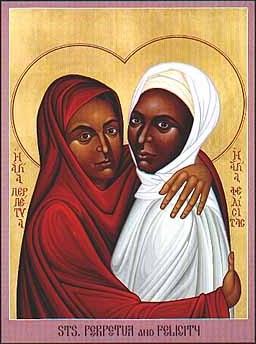
Before her death, St. Perpetua wrote an account of her sufferings, which we still have today. Obviously, someone else stepped up and finished the story after her death, but nevertheless, her autobiographical description is one of the first documents we have written by a woman--making St. Perpetua one of the first female writers! Her story was so popular, in fact, that St. Augustine had to warn his parishioners against giving it the weight of Scripture!

St. Perpetua was born around AD 181, in Carthage, a city of North Africa. She was the daughter of a wealthy Roman nobleman, and was married to a soldier. At that time in the Roman Empire, slavery was still a common and acceptable practice, and being a rich noblewoman, Perpetua had slaves. One of them was Felicity. But because they were of similar ages, and had both recently been married, and since Perpetua had just given birth, and Felicity was pregnant, the similar events in their lives led them to develop a friendship that went beyond slave-master.

At this time, in the Roman Empire, the Emperor, Caesar Septimus Severus had proclaimed that Christianity was illegal, and that it was therefore illegal to convert to Christianity, or to proclaim and teach the Christian faith to non-Christians. Those who were already Christians, or born into Christian families, were excluded from the government's censure, unless they tried to convert others--but for those who converted, the penalty was often death. Despite this, the Christians continued to spread the Gospel, convinced of its truth and importance. That was how St. Felicity's husband came to hear about Jesus, and he began learning about the Christian faith from a priest, Father Saturus. Felicity's husband, Revocatus, convinced Felicity to come and learn as well, and she in turn persuaded Perpetua.

These three, with two others (Saturninus and Secundulus), attended catechism in secret from Father Saturus. However, before they could complete their instruction, and be baptised the following Easter, the Roman government found out about their religious instruction, and had the five catechumens, as well as their priest, arrested. The date for their trial would not come right away, though, and they languished in their dungeon for months--awaiting a suitable occasion: the birthday of the Emperor!

During their time in prison, Fr. Saturus would continue to teach them the Christian faith, and, when they were catechised enough, he took some of their drinking water, and baptised each of them, since it would be impossible for them to wait for the following Easter. During this time, Perpetua's father, who was a nobleman and thus had influence, was permitted to visit Perpetua. But far from bringing joy and relief to her, she writes that his visits only served to vex her further, since he, as a Pagan Roman, continually tried to convince Perpetua to abandon the Christian faith to save her life. He appealed to her reason, to her honour and to her family's honour--to not die so shameful a death. But most of all, he appealed to her mother's heart, for who would take care of her newborn baby? Perpetua knew that her son would be starving without her to feed him, since he hadn't been weaned yet. But on one of her father's visits, he brought her mother and also her brothers, one of whom himself was also secretly learning the Christian faith (though, obviously, he hadn't been caught yet), and he went to the Deacons of the Church in Carthage, who bribed the guards to let Perpetua's baby be brought to her. And so she was able to feed her son until her trial.

Furthermore, Perpetua's brother also asked her to pray to God, that maybe she'd be granted a vision that would indicate whether her current sufferings and imprisonment would lead to martyrdom. She agreed, and in fact did receive a vision. Here's her account:
I beheld a ladder of bronze, marvelously great, reaching up to heaven; and it was narrow, so that not more than one might go up at one time. And in the sides of the ladder were planted all manner of things of iron. There were swords there, spears, hooks, and knives; so that if any that went up took not good heed or looked not upward, he would be torn and his flesh cling to the iron. And there was right at the ladder's foot a serpent lying, marvelously great, which lay in wait for those that would go up, and frightened them that they might not go up. Now Saturus went up first (who afterwards had of his own free will given up himself for our -sakes, because it was he who had edified us; and when we were taken he had not been there). And he came to the ladder's head; and he turned and said: Perpetua, I await you; but see that serpent bite you not. And I said: it shall not hurt me, in the name of Jesus Christ. And from beneath the ladder, as though it feared me, it softly put forth its head; and as though I trod on the first step I trod on its head. And I went up, and I saw a very great space of garden, and in the midst a man sitting, white-headed, in shepherd's clothing, tall milking his sheep; and standing around in white were many thousands. And he raised his head and beheld me and said to me: Welcome, child. And he cried to me, and from the curd he had from the milk he gave me as it were a morsel; and I took it with joined hands and ate it up; and all that stood around said, Amen. And at the sound of that word I awoke, yet eating I know not what of sweet.

And at once I told my brother, and we knew it should be a passion; and we began to have no hope any longer in this world.
(Meaning, of course, that they placed all their hope in Heaven, not that they gave in to despair.)

The six Christians continued to pray with each other and encourage each other as the day approached, but St. Felicity grew more and more worried. You see, she was still pregnant, and was not due to give birth until after the date slated for execution. According to Roman law, a pregnant woman could not be tortured or executed until after she had given birth. St. Felicity was worried not so much about being tortured or executed for Christ's sake, but that she would not be able to be martyred along with her friends. It's often hard to do the right thing. That's especially the case when it comes to giving your life. But it's even harder when you have to do it alone. Felicity was worried that when her time came, without her friends' encouragement she would not find the strength within her to confess Christ.

The six prayed together about this, and although Felicity was only about eight months pregnant, a week before their trial, she gave birth to a healthy baby, who was arranged to be adopted by a Christian family. In this, God showed that He was still with them, and cared for them, even in that dark prison. His asking of them to lay down their lives was not a sign that God had abandoned these six brave Christians, but rather, that He had singled them out for greater honour!

The day before their martyrdom, the six were allowed to have whatever they desired as a "last meal". Unanimously, they chose to have bread and wine, which Fr. Saturus blessed, and so they celebrated the Mass together. When the day finally came for these six great saints to be martyred, they were led to the arena in Carthage, to be tried by the magistrate. Each in their turn were asked whether they would renounce Christ and sacrifice a goat to Caesar and worship him, and each in their turn refused, claimed to be Christian, and were sentenced to be thrown to the wild beasts.

When it came time for Perpetua to be tried, however, not only the magistrate, but also her own father, attempted to convince her to abandon the Church. Her father came forward, carrying her baby in his arms, and appealed again to Perpetua to recant and live, so that her baby wouldn't die of starvation, for lack of milk. But again, through God's grace, He made it so that the baby was already weaned before his time, and no longer needed his mother to live. Thus, Perpetua, with her friends, professed herself a Christian, and was sentenced to death.

While the men were sentenced to face off against leopards and bears, out of spite and mockery for their femininity, the court sentenced Perpetua and Felicity to be attacked by a cow (a symbol of motherhood, and a mockery of these two mothers). When the two courageous women were thrown into the arena, Perpetua's robe tore, and she took the time to tie it so that she would appear modest and decent, taking more care for her modesty than for her own wounds. She even tied back her hair, since messy, unkempt hair was a sign of mourning in her culture, and she didn't want anyone to think that she was sad at her fate, but courageous and confident in God. She turned to help up Felicity, and immediately was led off to the side of the arena to rejoin the men who had survived the beasts. When there, she asked them, "When are we going to face the cow?" Amazed, her friends said to her, "You already have! It's hurt you! Look at yourself!" Perpetua and Felicity had been blessed by God to have had an ecstatic encounter with him, so that they were spared the pain of the cow's attack. In fact, Perpetua had to be shown her own wounds before she would believe her friends!

Afterward, all of them were led out again, and sentenced to be killed by the sword. The courage of these martyrs, particularly of the women, touched the audience so much, that many of them became Christians, including the jailer of the martyrs. It was one of these converts who finished the account of Perpetua's and Felicity's martyrdom, so that others in future generations would hear about and be inspired by their courage and sacrifice. In the author's own words:
O most valiant and blessed martyrs! O truly called and elected unto the glory of Our Lord Jesus Christ! Which glory he that magnifies, honors and adores, ought to read these witnesses likewise, as being no less than the old, unto the Church's edification; that these new wonders also may testify that one and the same Holy Spirit works ever until now, and with Him God the Father Almighty, and His Son Jesus Christ Our Lord, to Whom is glory and power unending for ever and ever. Amen.
God bless.

Labels: , , , , , ,

Tuesday, November 07, 2006

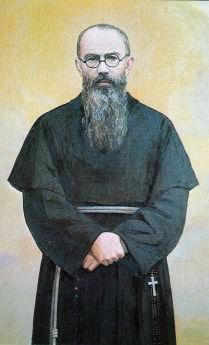
St. Maximilian Kolbe - 1941

Since Remembrance Day is coming up, I figured it would be good to relate the story of a Saint who played a large role in World War II.

Raymond Kolbe was born in 1894, in Zdunska Wola, Poland. Throughout his childhood, Raymond was quite a troublemaker. Very mischevious, he was always trying to get away with something, and his parents often considered him to be quite a trial. However, in 1906, around the time of his First Communion, things changed for Raymond. One night, he had a vision, and in that vision, he saw the Blessed Virgin Mary, and he asked her what was to become of his life. In response, she held out two crowns: one white, and the other red. The white one, she said, represented a life of purity, and the red one, a death of martyrdom. She told him he could choose a crown. Raymond decided to choose both.

Raymond chose to enter the priesthood with the Fransiscans, and took the name Maximilian. While in seminary, he and some friends started a club known as The Crusaders of Mary Immaculate, who were dedicated to spreading the Gospel of Jesus, the conversion of sinners, devotion to Mary, and to the Miraculous Medal.

After his ordination, St. Maximilian founded a Fransiscan monastery in Warsaw, Poland, in order to further spread faith in Christ and devotion to the Miraculous Medal, known as "The City of the Immaculate". After a while, though, he became restless, and felt God wanted him to travel as a missionary. So in 1930, Maximilian Kolbe went to Nagasaki, Japan, and there founded another monastery. After that, he continued on to India, doing the same thing, but illness caused him to have to return to Poland in 1936.

(Incidentally, Nagasaki was one of the two cities, with Hiroshima, that the USA dropped nuclear bombs on at the end of World War II, in retaliation for the Japanese attack of Pearl Harbour. The atomic bombs decimated nearly everything in those two cities--but, miraculously, St. Maximilian's monastery, and all those within, survived the bombing. Just one of the miracles attributed to devotion to the Miraculous Medal.)

Back in Poland, Maximilian continued his priestly duties, and overseeing the monastery there. On top of this, he began to publish and write for a newsletter called "The Knight". In it, he would teach about the love of Christ, and also address issues of justice and right living. When Adolph Hitler came to power in Germany in 1939, and began his Holocaust of the Jews and others who weren't of the Aryan race, many refugees began to flee from Germany to escape the oppression and persecution. Many of these refugees came to Poland, and Maximilian was able to put his teachings on love and justice into action, by hiding refugees in his monastery, and caring for them there. At one point, he had about 3000 refugees hidden in the monastery, and at least two-thirds of them were Jewish, because he knew that God loves all people, not just those of a certain ethnicity or religion.

For this act of hiding refugees, and for continuing publication of The Knight, which the Nazi Party considered to be Anti-Nazi, when Germany invaded Poland at the beginning of the War, Maximilian Kolbe was arrested and put into the Polish prison of Pawiak, on February 17, 1941. On May 28th, he was transferred to the Auschwitz concentration camp, in Germany, and even then was put in the worst sector--with particularly cruel guards--because he was a priest. There he was often beaten and deprived of food. Through it all, though, he continued to tell others about Christ, and to hear Confessions. He even, when he could get his hands on some smuggled in bread and wine, would say Mass and give other inmates the Eucharist!

After about a month and a half, there was an escape from Auschwitz. Protocol dictated that for every escaped prisoner, ten others were to be executed in his place. So the Nazis rounded up several people. One of them was a Jewish man named Franciszek Gajowniczek. He cried out, "Please! I have a wife and four children! Please don't kill me!" The guards were pitiless to his cries, but St. Maximilian Kolbe stepped forward and said, "This man has a wife and family. I am a priest. I have no wife, no children. Kill me instead and let this man go free."

In making this sacrifice, Maximilian lived out the two crowns that Our Lady had offered him: the purity of the priesthood, and the martyrdom of charity. He died on August 14th, 1941. Franciszek Gajowniczek did survive Auschwitz, and because of Maximilian's sacrifice, he and his family converted to Catholicism!
No one in the world can change Truth. What we can do and should do is to seek truth and to serve it when we have found it. The real conflict is the inner conflict. Beyond armies of occupation and the hecatombs of extermination camps, there are two irreconcilable enemies in the depth of every soul: good and evil, sin and love. And what use are the victories on the battlefield if we ourselves are defeated in our innermost personal selves?

Saint Maximilian Kolbe in the last issue of The Knight

Labels: , , , , , , , ,

Tuesday, October 10, 2006

Sr. Leonella - 2006 (Sept. 17)

In the last post, I wrote about St. Stephen, the first Christian martyr. This post, we'll be skipping forward to very nearly the latest Christian martyr! She's not on my Get Holy or Die Tryin' t-shirt. She was still alive when it was made! In fact, Sr. Leonella only joined the ranks of martyrs a short three weeks ago, though she seemed to expect it for many years.

Thirty-eight years ago, Sister Leonella decided to consecrate her life to God, and become a nun. She made her perpetual vows and joined the Order of the Sisters of Consolation, and went to Kenya to work in a hospital among the poor and suffering just outside of Kenya's capital, Nairobi. Her infectious enthusiasm and love for her patients and all she met earned her great love and respect in her community. After working there for many years, her fellow sisters even elected her to Regional Superior at the hospital, which she did for 6 years! While she was in that position, she trained new sisters for the work of loving and caring for the poor, and trained them to be nurses in the hospital. During this time, she was able to get the World Heath Organisation to recognise the sisters in her order as validly certified nurses!

After 6 years, in 2001 she took a sabbatical, and travelled to Mogadishu, Somalia, to investigate starting a hospital there through the SOS Village organisation. Her vision became a reality the next year, and she was also in charge of the nursing school there.

In going to Somalia, ravaged by civil war for over 15 years, and still now in a state of uneasy peace and civil unrest, with an Al-Qaida cell vying for political power, Sr. Leonella knew the risks she faced as a Catholic nun. She would often joke, even back in Kenya, that one day there would be a bullet with her name on it. But the risk didn't deter her. Neither did her often poor health or the struggles with governments and bureaucracies. Through it all, she continued to work for and to love the people of Africa. But she wasn't naively unaware of the risks, either. One of her sisters had been kidnapped in the previous year. She was found and her kidnapper sentenced to one year, but this and other attacks and threats to their lives prompted Sr. Leonella to hire a bodyguard to protect her.

On September 17th, 2006, after making the rounds of the hospital she helped begin in Mogadishu, she and her bodyguard were crossing the street 30 feet to her home, where five of her sisters were waiting to have lunch. As she and her bodyguard crossed the street, three gunmen, lying in wait, shot her, killing her and her bodyguard execution-style. When her sisters heard the shots, they ran out of the home to see what was going on. As the gunmen fled, the sisters carried Sr. Leonella and her bodyguard back into the hospital, but it was too late. As Sr. Leonella lay dying, she kept repeating "Pardono, pardono, pardono..." which is Italian for "Forgive, forgive, forgive..." Just like St. Stephen, Sr. Leonella prayed to forgive her enemies, and, at the same time, instructed her fellow sisters, and everyone else around, that they must forgive her killers, too, and not become bitter and hateful.

At her funeral, the Bishop remarked on her life and on her love. He also remarked on the circumstances of her death, and her dying with her bodyguard. He said that if a man and a woman could die together; a black man and a white woman; a Muslim man and a Catholic nun, could die together, then it was a sign of hope that we could live together, in peace.

That's the vision that Sr. Leonella had for Somalia. And through her love, she lived out that vision daily. Pope Benedict XVI echoed Tertullian, when he expressed his prayer that "the blood shed by so faithful a disciple of the Gospel may become a seed of hope to construct authentic brotherhood among peoples."

Many in the news speculated that Sr. Leonella was murdered as a reaction to the Pope's remarks made in a lecture last month about how violence is incompatible with the nature of God, and cited Islam as an example of spreading the faith by the sword. It prompted many protests from Muslims throughout the world, but in Sr. Leonella's case, let's remember again, that she'd already been threatened, and a fellow sister had even been kidnapped, before the Pope had ever made his speech. She didn't have a bodyguard for nothing!

Let us remember Sr. Leonella's legacy of love and forgiveness, and her inspiring courage in the face of many tremendous obstacles! Let us be full of courage in our own lives, as we reach out to help others with the love of God.

Amen.

Labels: , , , ,

Friday, October 06, 2006

St. Stephen - c. 33

We'll begin our look at the lives (and deaths) of martyrs with the story of St. Stephen, since he was the first Christian martyr. Stephen lived at the same time as Our Lord, and, in fact, died about the same year as Jesus Himself was crucified! He may (or may not) have even met Jesus Himself during His earthly ministry.

After Jesus had come, preaching about God, and how to love God and each other, He was crucified. But, since, not being just a normal human being, but, in fact, God Himself, He rose again on the Third day. After this, He commissioned His disciples to complete the work He had started, and to build His Church. He promised them the Holy Spirit, so that they would be able to accomplish His mission.

And so the Church began, on the day of Pentecost, as the Holy Spirit descended and filled the believers. And they, empowered by Him, went out and preached about Jesus, and His love and forgiveness. And many people believed in Him. But the Church knew it was not enough simply to proclaim God's love, but to actually live it out. And the early church in Jerusalem did this radically. Christians would even sell their own valued possessions, and use the money to buy food for the poor! Think about that: going home, and selling your television, your Xbox, your skateboard, your car, or even the computer on which you're reading this! And then, use that money to go and benefit the poor and needy around you!

This is what the earliest Christians were doing. But before long, a problem arose: The early Christians were Jewish, and as they did these loving acts, they made sure that the poor Jewish people of Jerusalem were looked after. But the problem was this: Not all those who lived in Jerusalem were Jewish. And there were many poor Greek people who also were in need. So they came to St. Peter, and asked him to make sure that they wouldn't be overlooked in the daily distribution of food. St. Peter said to them, "I have to run this whole Church, and study the Scriptures in order to teach about Jesus. I can't wait tables, too! But this is a serious problem, so here's what we'll do. We'll appoint seven men to be Deacons, and their job will be to make sure that everyone is looked after fairly and properly.

(Notably, the Catholic Church still ordains Deacons, and their primary vocation is still social justice in the community and in the world--and it began with these seven men, in Acts chapter 6!)

The very first person picked as a Deacon was St. Stephen, and he was chosen, according to the Bible, because he was "full of faith and of the Holy Spirit" (Acts 6:5). The Holy Spirit working in Stephen gave him the humility, the courage, and the love to reach out to the poor with kindness. Now, Stephen was a bright and handy fellow. He could have made a career doing anything. He could have made a terrific living for himself, and been considered very successful in the world's eyes. But instead, he gave it up, in order to serve the poor and lowly. And this choice led many people to wonder about him. What would make a person choose to live a life like that? And they would ask Stephen about it, and he would answer, "A couple of years ago, there was this guy, Jesus, who came, and taught us how to love. He was amazing, doing miracles and wowing everyone. But the authorities became jealous and angry at Him, because He made them aware of their need to change. And rather than change themselves, they chose instead to kill Him. They crucified Him, but He rose again, and told us to carry on preaching and acting out God's love. And because of Him, and His love for us, I'm here helping the poor."

And whenever Stephen had the opportunity, he would tell people about Jesus. But, as I said, Jesus had only been crucified earlier that year. And those people who didn't like Jesus were still alive, and they still didn't like Jesus. And they weren't too fond of those people who talked about Him. So they came to Stephen and they said, "We don't want you talkin' about Jesus anymore. Quit it." And Stephen said, "Uh, no. I love Jesus way too much to stop talkin' about Him." So they said again, "Shut up, or we'll make you shut up!" Stephen replied, "Jesus is just too awesome for me to stop talking about Him!"

But you can't just kill someone who devotes his whole life to serving the poor! Someone like that has way too much respect in society. So his enemies plotted amongst themselves, and they started making up lies about horrible things that Stephen supposedly had done. And they told the authorities, and came back to Stephen, and said, "Because of all the horrible things we say you did, we're going to kill you," and they picked up stones to throw at him.

Now, I don't know about you, but if someone made up a bunch of lies about what a horrible person I am, and began throwing rocks at my head because of it, my first response would be to pick up my own rocks and throw them right back: "Oh, it's on, now!"

But as the mob was stoning Stephen, he did not retaliate, but instead prayed, "Lord, do not hold this sin against them." And as he died, he saw a vision, of Jesus standing up in Heaven, welcoming him home (Acts 7:60, 56).

Now, while the world might consider a person who gives up everything in life to follow God, and then ends up killed for it, a colossal failure, we recognise St. Stephen as a great hero. The reason we do so, is because we recognise that Stephen's death is not the end of the story.

As Stephen was being Crucified, he prayed for God to forgive his very killers! That kind of love can only come from the Holy Spirit in one's life! But the amazing thing is, all of us who are Christian have that same Holy Spirit! And as we grow closer to Him, and make ourselves more available to Him, we too will be filled with that same love that Stephen showed. And that love will have serious effects, as we see from Stephen's story. Because as Stephen was being stoned, one of the people in the crowd, one who had a rather large part in instigating the stoning, was a man named Saul.

Now Saul was rather anti-Christian. So much so that, after Stephen died, he went around trying to arrest and even kill other Christians. One such mission of his took him to a town called Damascus--but on the way, Saul had an encounter with Jesus. As he travelled, Saul saw a bright light that knocked him right off his horse, and heard Jesus say to him, "Saul, why are you persecuting Me?" Saul didn't know what to say, and so replied, "Who are You, Lord?" Jesus replied that He was Jesus, and that Saul would go on to Damascus to seek out a Christian, but not to kill him, but rather, this person, Ananias, would pray for him and baptise him, and Saul would become a great witness to Jesus!

In this remarkable way, Jesus answered the prayer of Stephen to forgive his killers, which Stephen prayed as he died, and let me tell you, continued to pray after he arrived in heaven! And Saul was the first one to receive the grace of those prayers, when he was baptised in Damascus, and changed his name from Saul, to Paul.

It was this Apostle Paul who spread the faith throughout the Roman Empire, starting many, many churches, writing nearly half of the New Testament, and finally, dying as a martyr himself, beheaded by the Emperor Nero! This is the legacy that St. Stephen's martyrdom gave to the Church!

And each of us, through the Holy Spirit, are able to live such a heroic life of faith, and to impact our generation with the Gospel of Jesus Christ! We need only to be willing to yield our own lives to the Holy Spirit inside of us!

God bless!

Labels: , , , ,

Tuesday, May 30, 2006

Hope

Romans 1:1-5
So then, now that we have been justified by faith, we are at peace with God through our Lord Jesus Christ; it is through Him, by faith, that we have been admitted into God's favour in which we are living, and look forward exultantly to God's glory. Not only that; let us exult, too, in our hardships, understanding hardship develops perseverance, and perseverance develops a tested character, something that gives us hope, and a hope that will not let us down, because the love of God has been poured into our hearts by the Holy Spirit which has been given to us.
A few weeks back, I had one of the crappiest times of my life. Pressures of youth ministry were weighing me down. I was simultaneously dealing with two separate issues within the youth group, as well as just trying to run it, and just as I had to do something that was unconscionably hard, but necessary and right, I found out that a dear friend of mine had departed from the faith! I was weighed down by all the evil in our society and in the world, and really quite depressed.

I was listening to a cd by Jars of Clay, titled If I left the Zoo, and track 7, "Hand", really reflected how I was feeling, but then, at the same time, reminded me that through it all, God gives us hope to carry on:
Hand
Jars of Clay

I'm here waiting for something new to break my heart
So callous laden, I can't feel a thing at all
So will You catch my fall?

From lost and not found, to run and not hide
My hand inside... (Your hand)

Fear is keeping time with the beating of my heart
Doin' way too much thinkin'
And it's tearing me apart
But I, I feel You reach for me

From lost and not found, to run and not hide
My hand inside... (Your hand)
Losing my grip falling so far
My hand inside Your hand

I hear Your voice and follow
So hard to believe, and still I go
Still I go...

From lost and not found, to run and not hide
My hand inside... (Your hand)
Losing my grip falling so far
My hand inside Your hand
It was the second verse that really impacted me, and reminded me that truly, when life gets to its darkest, and throws everything it can muster to knock you down, that God is still reaching out to us, to take us by our hand and lead us on. It's not our strength that carries us through, but His, and even when we feel our hand, our faith, our hope, slipping, Jesus is still holding on, as tight as ever.

So no matter what is getting you down, hold on.
Jesus gives us Hope, and that hope doesn't let us down, because it's Him, and not us, that is the guarantee!

God bless.

Labels: , ,

Thursday, May 18, 2006

The Two Ways

Matthew 7:13-29
"Enter by the narrow gate, since the road that leads to destruction is wide and spacious, and many take it; but it is a narrow gate and a hard road that leads to life, and only a few find it.
"Beware of false prophets who come to you disguised as sheep but underneath are ravenous wolves. You will be able to tell them by their fruits. Can people pick grapes from thorns, or figs from thistles? In the same way, a sound tree produces good fruit but a rotten tree bad fruit. A sound tree cannot bear bad fruit, nor a rotten tree bear good fruit. Any tree that does not produce good fruit is cut down and thrown on the fire. I repeat, you will be able to tell them by their fruits.
"It is not anyone who says to Me, 'Lord, Lord," who will enter the Kingdom of Heaven, but the person who does the will of My Father in heaven. When the day comes many will say to Me, 'Lord, Lord, did we not prophesy in Your name, drive out demons in Your name, work many miracles in Your name?' Then I shall tell them to their faces: I have never known you; 'away from Me, all evil doers!'
"Therefore, everyone who listens to these words of Mine and acts on them will be like a sensible man who built his house on rock. Rain came down, floods rose, gales blew and hurled themselves against that house, and it did not fall: it was founded on rock. But everyone who listens to these words of Mine and does not act on them will be like a stupid man who built his house on sand. Rain came down, floods rose, gales blew and struck that house, and it fell; and what a fall it had!"

Jesus had now finished what He wanted to say, and His teaching made a deep impression on the people because He taught them with authority, unlike their own scribes.
Jesus compares the Spiritual Life to a journey, where we come to a fork in the road. To the left is a huge, 4-lane, paved freeway, well maintained and well lit. A very safe road. To the right, on the other hand, is a narrow, pot-hole-ridden, gravelly, bumpy, hard road. And on this journey, Jesus tells us that we must take that hard road. The world tries to tell us that all roads lead to God, but Jesus plainly tells us that these two diverging paths (and, ultimately, there are only two) go in opposite directions. The wide, safe, paved freeway leads to Destruction, while the narrow, difficult road leads to everlasting Life.

Why is it that the hard road is the right road? Why is it that God didn't make it hard to go to Hell, and easy to go to Heaven?

All living creature grow and change. To cease to grow is to die. This is true with our spiritual life as well. The hardships that come in following Christ and being obedient to His commands help us to grow. Without them, we would never be challenged or stretched, but we would become complacent, static, and we would die. Through the harships, the hard choices and hard actions, we rise to the challenge. Our faith, courage and strength are tested, and through God's Grace, we overcome and grow more and more like Christ--and that's what it is all about!

But this attitude is insanity to the world. Our world desires the easy route. It desires to live in peace and luxury, not to struggle. Like electrons, we desire to take the path of least resistance. And the world, therefore, tries to dissuade us from taking the hard road. It beckons us to follow the easy road to hell. It constantly tries to undermine the truth of Christ and His Church. Things like The Gospel of Judas or The Da Vinci Code tell us that the Church has lied to us about the Gospel. People tell us that we don't need to follow God--that it's futile and meaningless. They tell us we are our own gods. But these things are all lies, and dangerous lies, designed to lead us astray. And if we are not careful and discerning, if we are not staying close to the Truth, we can be led astray. The False Prophets, Jesus says, are like wolves dressed up in sheep's clothing. They sound clever, they sound reasonable, many times they even sound Christian. But their lies are exposed in their lives. If their message does not bring us to a closer relationship with Jesus Christ, or to a greater willingness to obey His Will, then it is false. If their message claims to bring us closer to Christ without the necessity of keeping His commands, it is false. If their message appears to lead to righteousness without Christ, it is false.

Jesus said, it is not everyone who says, "Lord, Lord," that comes into His Kingdom. We need also to do what God wants us to do. Note that many of these false prophets will even claim miraculous signs as their proof! We can't be fooled! God's will is not to do miracles (though they may often accompany those who do His will). God's will, rather, is "only this, to do what is right, to love loyalty and to walk humbly with your God" (Micah 6:8).

If we do not do the Will of God, we won't be accepted into His Kingdom. Jesus finishes with the parable of the wise and foolish builders--the wise one who builds upon the solid foundation, and his house stands against all adversity, and the foolish one who builds on sand, and his house crumbles right away. It is not enough to hear the word, Jesus says, but we must act on it.

I'll conclude with a poem that I wrote when I was 16, reflecting on a girl I knew who gave up the Christian life for peer pressure, getting into drugs and other sinful behaviour. She left the narrow road, for the wide freeway. If we walk away, know that God always calls us back, asking us to turn around and regain the Narrow Way.
Holes in His Soles
(C)1996 Gregory Watson

Sweet girl, on a journey,
Growin' up, you're in a hurry.
Seek new things to get you by,
Always new, you want to fly!

Sweet girl, the road you're takin',
It looks all right, but you're mistaken.
Might look brilliant, might look bold,
But "all that glitters isn't gold."

Sweet girl, you missed the exit,
Go back a way, see if you can find it.
Careful though, wolves hide the gate,
They dress like sheep, don't take the bait.

"'Because narrow is the gate...
And there are few who find it.'
Wolves in sheep's clothing
Are trying to hide it."

So girl, take my hand,
I'll lead you back, to find the Man
Who built the gate and now protects it.
He guides us home, and will keep the way lit.

Sweet girl, look at His footprints.
See the holes in the middle of those imprints?
Listen now, I will tell how and why.
You see, He got those marks for you and I.

This Man's Dad so much loved us
He sent His Son to make a way for us.
So He came and worked from early 'til late,
And when He'd finished, there stood a gate.

One post up, one post across
It stands, a landmark to those who are lost.
The wolves, the fearsome stalkers of night,
They hated the Man, and His gate of light.

They killed Him in their hate.
Nailed His hands and feet to the gate.
All night the wolves howled and taunted,
Fear not though, this is what He wanted.

He died, and all was dark.
Those wolves, they ceased to bark.
But the Builder, dead He didn't stay!
He lived again on the third day!

The wolves ran in a defeated state.
With His blood, He christened the gate.
"It is finished!" the Son exclaimed
From Calvary, what the gate is named.

So that, sweet girl, is why
His feet are marked: for you and I.
His footprints guide us over rock and sand,
Down the road to the Promised Land.

So when the wolves come to cajole,
Follow the tracks with the hole in the sole.
This Man will keep the wolves at bay.
Follow Him close; He'll not lead you astray.

And now, sweet girl, I say adieu.
I must go and help others just like you.
They seek new things to get them by,
Always new, wanting to fly!

"'Because narrow is the gate...
And there are few who find it.'
Wolves in sheep's clothing
Are trying to hide it."

Follow close the prints with the hole.
Keep with the Guide; He'll heal your soul.
Follow the tracks over rock and sand,
One day you'll come to the Promised Land.
This concludes our study of Jesus' Sermon on the Mount.

God bless!

Labels: , , , , , ,

Tuesday, April 25, 2006

Faith

Before I became the Youth Minister here at St. Andrew's, I used to run a Drop-In Centre up near Guelph, known as "The Rock," for "unchurched" kids. Basically, it was a weekly drop-in, put on by local churches, in order to provide a place for teens to hang out on a Friday night. I ran it for a little over 2 years, and it was great.

Recently, one of those kids was doing a Philosophy project for his high school class on whether God exists. This guy is not a Christian, by any stretch of the imagination. He calls himself an agnostic. In doing this presentation, he posted his thoughts from his studies on his blog, "Kataron's Blog". One of our mutual friends, Eric, sent me an email saying that I should check Nate's blog out and comment. So I did, and I read this article:
More God Stuff
I'm too tired to continue my earlier stuff, but after a few comments on that post, I have something on my mind.

One of the things that bothers me most about people is when they assume that they're right, that they have some sort of knowledge that others do not possess. In the case of the comments on the last post, it's Christians assuming themselves correct about all things God. And, of course and to be fair, it's not only Christians, it's a whole lot of other people, but in this case right here, it's Christians. And I understand, I guess. It's what they believe. But it's always just irritated me when somebody tries to tell somebody something with no evidence to support it whatsoever.

And let's face it, religion in general, and I'm talking all religions around this globe of ours, runs on little to no evidence. The Bible? I'd hardly count that as evidence, it's a book. Besides, if we're to believe everything that's written in the Bible...Well then. Too many things in there are just too unbelievable to even be considered as truth. In my oh-so-humble opinion, they're stories on how to live your life. Like fairy tales with morals and such. Don't trust strangers, don't set fire to your pants, etc. But of course, I could be wrong. Everything there could be absolutely true. It's absolutely impossible to know.

This is why I can't believe in any sort of God. I'm an empiricist. I can't believe in anything without evidence. Not really. This goes back to my whole philosophy that I've discussed oh-so-many times. Where everything out of my immediate sensory range does not exist. So right now, as I write this, none of you exist. It's a bit weird if you're...well, sane, but I like my philosophy. But yeah.

I can't believe in anything that I don't have evidence for. That's part of why I go to the youth group, part of why I chose this seminar topic. I'm trying to figure out exactly what's what in the universe at large, but none of the quote unquote "evidence" I find just doesn't cut it for me. Proof is very difficult to come by. With...Well, anything.

But that's what irritates me about people, they firmly believe in these things that they have literally no evidence to support. Because I can't. I can't believe in anything without this evidence. So it usually ends up bothering me when people demonstrate that they can indeed believe in these things without proof. But I guess that's why it's faith, isn't it? But I can't freakin' do that. I can't have faith in anything.

So...Could somebody, Dave, or Eric, or somebody, tell me exactly how it is that you can believe in something without evidence? I don't understand. You can't possibly know this for sure. So how can you believe, how can you have faith in these things?

F*** I'm tired. I don't even remember half the things I said up there. I'm just gonna go sleep, and hope that it makes some sort of sense.

Until next time,
Indeed.
~Kataron
I was trying to think through a "why you should believe with absolutely no evidence" response. But I didn't get too far. Namely, because I don't believe you should believe something with absolutely no evidence.

Christianity, contrary to many people's opinions, is not "blind faith" (I mistyped while I was writing that, and almost said "blond faith". It's not that, either, I assure you). In fact, looking throughout history, Christianity has been believed by some of the most intellectual and intelligent people who have ever lived. Beyond specifically Christian faith, theism (the belief in God) of some sort has been believed by an even greater number of intelligent, thinking, and even empirical people.

But people, like my friend Nate, still believe that believing in God takes an enormous leap of faith, across a wide, bottomless chasm, with alligators in it. The leap is so dangerous or ridiculous in their minds, and impossible to actually make, that they don't even try.

However, throughout history, many of the brilliant men and women who believe in God, have thought out "proofs" that God exists (which is a bad term to describe them, since in contemporary usage, "proof" equates to "indisputable fact", whereas back in the renaissance era, when they were first known as "proofs", "proofs" merely meant "evidences"). Briefly, I'll examine the four major ones:

The Cosmological Proof
Initially presented by none other than Aristotle, the Greek Philosopher, this proof basically says that all matter comes from somewhere. Everything is caused by something. You're here, for example, because your parents fell in love, and, sparing you the details, had a baby. They're here because their parents did the same, and so on and on back to the original people. All life is the same, and so is all non-life. Everything that is around us had a beginning. Everything had a cause. Now, Aristotle says, we cannot keep going back forever with our causes. It is necessary that there be a First Cause--and that First Cause is what Aristotle called "God". So, in a nutshell, because there is a world, and that world had to come from somewhere, there must be a God to have made the world.

The Teleological Proof
Taking the Cosmological Proof one step farther, the teleological proof (yes, I know they have weird names. That's because philosophers love making up fancy-sounding names to make themselves seem even smarter) looks at this world, and sees how amazingly intricate and complex it is. That kind of complexity could not be the product of simple chance, but indicates a designer. Often this proof is known as the "Watchmaker Argument" because that is its most common analogy. If you found a watch lying on the ground, looking at its gears and springs and hands and numbers, and seeing how they all work together to make the watch keep accurate time, you would logically assume that someone designed and built that watch, rather than thinking that it was the result of some random convergence of metal pieces. So with the watch, so with the world: the way that everything works, from our solar system down to our DNA, and each piece fitting together and playing its part, indicates to us the presence of a Great Designer who made all of this. That Great Designer is God.

The Ontological Proof
This one is kind of my favourite, but not too many other people like it. Personally, I think that's just 'cause they don't get it. It was first thought out by St. Anselm of Canterbury in the Middle Ages. Basically, it goes like this: God is defined as "that which nothing greater can be conceived." That is to say, God is completely perfect, and if you listed a bunch of attributes or qualities, and compared which would be better, then God would possess the best attributes. So, what is better, for something to be physical or spiritual? Spiritual, therefore God is Spirit. What is better, for God to be evil or good? Good, therefore God is Good. What is better, for God to be all-powerful, or not? Obviously, all-powerful. And so on. Now, the clincher of this argument comes with the question, which is better, for this perfect being to exist, or not to exist? Obviously, such a being existing would be better than that same being not to exist. So since the definition of God used is "that which nothing greater can be conceived", and I can think of a God who does actually exists, and a God that is only imaginary, and that the imaginary God is obviously inferior to the real God, then, by definition, God must exist.

Think of it this way:
A: God = that something which nothing better could ever be thought up.
B: It would be better for something to exist than to just be imaginary
C: Therefore, if there is the choice between something which nothing better could ever be thought up, actually existing or not, then the one that exists is better than the one that doesn't
D: God, then, by definition has to exist.

I know, it's confusing. So on to the last proof:

The Moral Proof
This one was made popular by C. S. Lewis (The Chronicles of Narnia guy) in his book, "Mere Christianity". He points out that all people throughout the world have an inate sense of right and wrong. This sense of right and wrong is amazingly consistent throughout all cultures and all times, so much so that if your at the mall, trying to find a parking spot, and you are waiting for a person to get into their car so you can have their spot, and when that car pulls away, someone else swoops in and takes your spot, your immediate reaction is "That's not fair!" Why? Just because you didn't like what they did? No, but because you and the other person both recognise that your being there first entitled you to that spot. This premise of a moral law is how societies make their laws.

Now, the fact that each person is programmed wtih this law in their hearts is evidence that there is a Lawgiver who wrote that Law. Otherwise, morality would simply be a matter of choice, and there would be no ability to appeal to anyone's sense of fairness or decency--no one would have such a thing! So the fact that, whether we live by the morals we instinctively know to be right or not, we all know them, and therefore know that God has given them to us.

So this is some of the evidence for God. However, that evidence is "circumstantial." It proves that there is a likelihood of X conclusion, but does not do so without the possibility of other explanations. Without direct evidence, these proofs aren't enough to convict.

When we look at that bottomless pit of alligators that we call "faith", however, the logic of these and similar arguments drastically closes the gap. But as I said, the evidence could possibly be interpreted to fit different conclusions (the question isn't, "what's possible?" though, it's "what's most probable?"). So the great chasm is narrowed. For some people, it might be narrower than for others. The thing of it is, it's not closed. A leap of faith is still necessary.

But God is aware of this, and so He has taken it upon Himself to narrow the gap even further. He has, throughout history, revealed Himself to us--through prophets who speak in His name, through miraculous signs, and finally and most fully through Jesus Christ, who was God-in-the-flesh, who came to reveal the fullness of truth about God! Through that Revelation, God has closed the gap still further. Now the great Leap of Faith is much more of a simple step. But just as logic didn't take us all the way to belief, God doesn't reveal Himself so as to take away the necessity of faith. He makes faith in Him easier to have, but leaves faith as a necessary requirement. Why?

Because, as the Bible tells us in Hebrews 11:6:
Now it is impossible to please God without faith, since anyone who comes to Him must believe that He exists and rewards those who seek Him.
So, in my mind, there are two options. Have faith and wait for greater evidence, or wait for greater evidence in order to have faith.

As a Christian, I chose route #1, and I believe that I got the further evidences that follow. Our good buddy, St. Anselm, when writing his proof (see the Ontological proof above), said this: "Credo ut intelligam." In case your Latin's a little rusty, that's "I believe in order that I might understand." Not much of an empiricist, he was. But he understood the truth that I've been trying to relate above. On the one hand, God has, as one writer has put it, "left His fingerprints all over the world." On the other hand, that same God, who longs to know us, paradoxically hides from us. Why? To see if we'll take that step of faith and seek Him. God is not an academic abstraction. He is a person, who desires a relationship with us. But we have to reciprocate that, and we do that by faith, and seeking Him. God is playing hard-to-get.

Think of it this way: popular culture, many movies, etc. and many people believe in the concept of a "soulmate." They believe that out there somewhere is the person whom they are destined to be with. Now, if that's true, and a person believes it, then they have a level of "academic" or "theoretical" certainty. However, unless that person, in believing this truth about their "soulmate", acts on that "faith" and tries to seek this other person out, they will never find their soulmate. If there is a soulmate for that person, and that person is destined to be with their soulmate, that does not lead to the conclusion that the soulmate will simply fall from the sky into their lap. They have to participate in the search. And, perchance the soulmate did happen to fall from the sky into the person's lap (maybe the soulmate's into skydiving), the two people must still continue to work in order to make a relationship work.

The prophet Jeremiah, speaking for God, says this:
"When you search for Me, you will find Me; when you search wholeheartedly for Me, I will let you find Me" (Jer. 29:13-14, emphasis mine).
An atheist is not going to find God, unless he begins to search for God. But even in the searching, the atheist is no longer an atheist, because to search for something, you have to believe that it's there to find! The same is true for the agnostic. In some ways, the agnostic may actually be farther from finding the truth, because they, by definition, are committed not to a stance of "convince me", but "you can never convince me."

Only the romantic will find his soulmate, because he will be searching.

Only the theist will find God, because he will be searching.

God bless.

Labels: , ,

Friday, April 21, 2006

History Makers

I'm not personally involved in or associate with the Catholic Charismatic Movement, but I was raised Pentecostal. By definition, I am a charismatic Christian, even if my normal expression of my faith doesn't emphasise that. But every now and again, I get the urge for some good, Spirit-focused, charismatic teaching. Now is one of those times. :D
History Maker
Delirious?

Is it true today
That when people pray
Cloudless skies will break
Kings and Queens will shake?
Yes it's true!
And I believe it
I'm living for You

Is it true today
That when people pray
We'll see dead men raised
And the blind set free?
Yes it's true!
And I believe it
I'm living for You

I'm gonna be
A history maker in this land
I'm gonna be
A speaker of truth to all mankind
I'm gonna stand
I'm gonna run
Into Your arms

Well it's true today
That when people stand
With the fire of God
And the truth in hand
We'll see miracles!
We'll see angels sing!
We'll see broken hearts
Making history!
Yes it's true!
And I believe it
I'm living for You

I'm gonna be
A history maker in this land
I'm gonna be
A speaker of truth to all mankind
I'm gonna stand
I'm gonna run
Into Your arms

I'm gonna be
A history maker in this land
I'm gonna be
A speaker of truth to all mankind
I'm gonna stand
I'm gonna run
Into Your arms
Into Your arms
This song by Delirious? asks the question, "Is it true today?" Is it true today that when people pray, cloudless skies will break, kings and queens will shake? The imagery refers to the days of Elijah the prophet, who was sent by God to speak to the Israelites who had turned away from God to serve the false god, Ba'al, because of the rule of the wicked King, Ahab, and his wicked wife, Jezebel. God bestowed miraculous powers on Elijah, so that he prayed, and there was a droubt in the land for 3 years. During that time, Elijah called fire down from heaven as proof that God hears and answers prayer. At the end of those 3 years, Elijah prayed again and the rain came (check out 1 Kings 17-18).

Is it true today, that when people pray, we'll see dead men raised and the blind set free? The imagery here goes back to the Gospel, where Jesus raised the dead, and healed the blind, as well as many other miracles that attested to His identity as God come among us (Check out John 9 and 11, for examples). These miraculous signs were given by Elijah and by Jesus as evidence of the truth of their message. But the song doesn't ask, "Is the Bible true?" or "Did these things happen 2000-3000 years ago?" The song asks us, "Is it true today?"

Yes it's true!
We believe in a God who is present among us, who does not change, but is the same "yesterday, today, and forever". God did not retire from the miracle business! God is just as active in the world today as He ever was! But just as with Elijah, or the Apostles, God works through us, His people. And if we want to see miracles, then we've got to pray, we've got to believe, and we've got to be ready for Him to use us!

At our Confirmation, we received the Holy Spirit, and we were taught, correctly, that He gives us gifts: Wisdom, Understanding, Counsel, Fortitude, Knowledge, Piety, and Fear of the Lord. These gifts are found listed in Isaiah 11:1-2, and when the Spirit comes, He gives all of these gifts to each of us, and develops them within us as we respond to Him and use them.

But the Bible also tells us about other gifts that the Holy Spirit brings us. In 1 Corinthians 12, St. Paul writes,
There are many different gifts, but it is always the same Spirit; there are many different ways of serving, but it is always the same Lord. There are many different forms of activity, but in everybody it is the same God who is at work in them all. The particular manifestation of the Spirit granted to each one is to be used for the general good. To one is given from the Spirit the gift of utterance expressing wisdom; to another the gift of utterance expressing knowledge, in accordance with the same Spirit; to another, faith, from the same Spirit; and to another, the gifts of healing, through this one Spirit; to another, the working of miracles; to another, prophecy; to another, the power of distinguishing spirits; to one, the gift of different tongues and to another, the interpretation of tongues. But at work in all these is one and the same Spirit, distributing them at will to each individual (vv.4-11).
As St. Paul makes clear, unlike the first list of gifts, the Holy Spirit doesn't give all of them to everyone--but He will give some to each of us if we are open to receiving them! Why does He give certain ones to some and different ones to others? To remind us that, as the Body of Christ, we need each other, and that these gifts are to serve the entire Church! When we stand together in the Spirit, then spectacular things can and will happen!

So as you read this, I challenge you to be open to all that God has in store for you! Don't sell yourself short. Don't settle for less than all that God has! We all have a role to play in His Kingdom. Don't fall for the lie that religion is about church on Sunday and the rest of our lives the rest of the week. Follow God wholeheartedly, open to His Spirit, and you will see miracles! Imagine being the one that God uses to heal a desperately sick person! Imagine being the person whom God uses to speak His Truth into someone's life, and seeing them come to faith in Him! Imagine the adventure that God has for your life!

Then be obedient to it!
Be a history maker!

Labels: , , ,

Friday, March 10, 2006

What Are You Looking At?

Matthew 6:22-34
'The lamp of the body is the eye. It follows that if your eye is clear, your whole body will be filled with light. But if your eye is diseased, your whole body will be darkness. If then, the light inside you is darkened, what darkness that will be!
'No one can be the slave of two masters: he will either hate the first and love the second, or be attached to the first and despise the second. You cannot be the slave both of God and of money.
'That is why I am telling you not to worry about your life and what you are to eat, nor about your body and what you are to wear. Surely life is more than food, and the body more than clothing! Look at the birds in the sky. They do not sow or reap or gather into barns; yet your heavenly Father feeds them. Are you not worth much more than they are? Can any of you, however much you worry, add one single cubit to your span of life? And why worry about clothing? Think of the flowers growing in the fields; they never have to work or spin; yet I assure you that not even Solomon in all his royal robes was clothed like one of these. Now if that is how God clothes the wild flowers growing in the field which are there today and thrown into the furnace tomorrow, will He not much more look after you, you who have so little faith? So do not worry; do not say, "What are we to eat? What are we to drink? What are we to wear?" It is the gentiles who set their hearts on all these things. Your heavenly Father knows you need them all. Set your hearts on His kingdom first, and on God's saving justice, and all these other things will be given to you as well. So do not worry about tomorrow: tomorrow will take care of itself. Each day has enough trouble of its own.'
After Jesus finishes discussing the three major "do's" of the Catholic Faith: Almsgiving, Prayer, and Fasting, and teaching that it's not just enough to do them, but we must do them with the right motives--out of sincerity, rather than showing off--Jesus continues to discuss the motives of the heart very directly in this text.

He starts off with a proverb about being able to see, that at first glance, sandwiched as it is in Matthew between a discussion about true treasures and serving either God or money, seems completely random. If this section is about wealth vs. God, then why is Jesus talking about our eyes? In fact, this parable is the key to really understanding what it is that Jesus is getting at when He talks about finances. And, not surprisingly, it's the very same point that He's been making all along. Just as our eyes allow us to see, and if we can't see, everything is in darkness, spiritually, we need to have our heart focused on the things of God. If we allow distractions to take our eyes off of Him, then our hearts will grow spiritually dark.

Jesus then turns His attention to an issue that was as distracting for people as they tried to serve God in His day as it is now. In fact, it's such a huge issue that Jesus isn't content to refer to it as a "distraction." He's pretty graphic as He calls people "slaves" to it. And He's right. We cannot be a slave both to God and to Money.

Here in North America, especially, it seems to me, in our town of Oakville, the distraction, enticement, and downright slavery of money is very prevalent. People work long hours in order to provide the best sort of life for their family: the biggest house, right down on the Lake, the nicest cars, biggest television, etc. They think that if they make enough money, and get enough stuff, it will fulfil them, and they will be happy. The problem is, though, there is always something more to get, something more to "fill" that void in our hearts, and we never do get to the point where "enough is enough."

Now please hear what I am saying: money in and of itself is not a bad thing. As St. Paul said, "'The love of money is the root of all evils' and there are some who, pursuing it, have wandered away from the faith and so given their souls any number of fatal wounds" (1 Timothy 6:10, emphasis mine). Money, when it serves our needs, is a good thing. But there can easily come a point when money becomes not the servant, but the master, and we must be on guard against that!

As Jesus said, it's about what we are focussed on, and He continues to talk about where our focus should be. When Money is our master, our focus is on ourselves and all the things that we need. We begin to stress and worry over food and clothing and everything else, because "What if we don't have enough?" Rather, Jesus tells us not to worry about any of that, because God knows our needs and promises to take care of us! If He can take care of birds and flowers, giving them all that they need, then how much more is He aware of and willing to meet our needs, who are created in His Image, and are infinitely more valuable than flowers and birds! So He asks us to trust in Him and work with Him, instead of trusting in money and working for money.

This is not an easy thing. I get that. As a youth minister, my salary is far from lucrative! My wife is a supply teacher, trying to get a full-time job. In the meantime, she doesn't know if, when, or where she'll be working next! It's very difficult to trust that Jesus will supply our every need. It's very tempting to worry and get stressed out. It's very tempting to look into a better-paying job so that we can be secure enough to start a family, have a house, and all the other things that we think would make us happy. But we have faith in God, knowing that He's taking care of us, and has called us to the place where we are. As long as we cooperate with Him, He will not only meet our material needs, but our spiritual needs as well. As hard as things may get, He will fulfil that void in our hearts.

So don't worry about all these things. Seek God's Kingdom, and His saving justice! He'll take care of the rest. That's the beauty of having God as Our Father!

God bless!

Labels: , , , ,

Friday, September 23, 2005

Saint Doubting Thomas

Detail of Caravaggio: 'The Incredulity of Saint Thomas'
Over the next several weeks, the grade nine classes of St. Thomas Aquinas are having retreats here at St. Andrew's Church, to help get the freshmen off to a great spiritual start to their high school careers. I was asked to be a part of the retreat, and as the theme was how Jesus meets us in the challenges of high school, and overcomes them, I thought I'd offer a meditation on one of my heroes of faith, St. Thomas the Apostle.

I want to read a passage of Scripture to you, about a fairly famous fellow in the Bible, though, sometimes not one with the greatest of reputations. He's one of my heroes though, particularly because of this story--and I think his story will provide some encouragement for you as well, as you begin your journey through high school. But you'll see what I mean.

John 20:19-29
In the evening of that same day, the first day of the week, the doors were closed in the room where the disciples were, for fear of the Jews. Jesus came and stood among them. He said to them, 'Peace be with you,' and, after saying this, He showed them His hands and His side. The disciples were filled with joy at seeing the Lord, and He said to them again, 'Peace be with you.
'As the Father has sent Me,
so I am sending you.
'
After saying this He breathed on them and said:
'Receive the Holy Spirit.
If you forgive anyone's sins,
they are forgiven;
if you retain anyone's sins,
they are retained.
'
Thomas, called the Twin, who was one of the Twelve, was not with them when Jesus came. So the other disciples said to him, 'We have seen the Lord,' but he answered, 'Unless I see the holes that the nails made in His hands and can put my finger into the holes they made, and unless I can put my hand into His side, I refuse to believe.' Eight days later the disciples were in the house again and Thomas was with them. The doors were closed, but Jesus came in and stood among them. 'Peace be with you,' He said. Then He spoke to Thomas, 'Put your finger here; look, here are My hands. Give Me your hand; put it into My side. Do not be unbelieving any more but believe.' Thomas replied, 'My Lord and my God!' Jesus said to him:
'You believe because you can see Me.
Blessed are those who have not seen and yet believe.
'

I love St. Thomas the Apostle. I have to say, he's definitely one of my favourite disciples of Jesus (if I had to rank them, I'd put him probably at number 2, behind John). He is definitely one of my heroes of faith. Hold up, what? A hero of your faith?! We are talkin' about Doubting Thomas, right? Like, the one that doubted. How can he be a hero of faith?! Yes, Doubting Thomas is one of my heroes. He's gotten a bit of a bad rap throughout history. He's that poor excuse for an Apostle. "That's the doubter!" "He didn't have faith!" "He had to see to believe!" "What kinda weak, wishy-washy, lameoid disciple is that?!"

See, I like Doubting Thomas 'cause he's real. He's human, like me. Here's a guy who spent the last three years of his life following Jesus around, firmly believing that Jesus is this big ol' Messiah come to save the world. He's the greatest guy who ever lived. He's travellin' around, preaching about God and His Kingdom, and healing people, doing all kinds of miracles, and really just blowing people away. Then things got nasty, and Jesus' wonderful preaching, healing, miracle-working Messiah-tour got cut short. He was arrested and then Crucified! Thomas' teacher, his best friend, his hero--and they killed Him!

So I figure Thomas is rather shaken up by all of this. His whole identity and sense of purpose just got pinned to a big nasty tree. He's probably wandering around in a depressed stupor, and totally misses the next three days. When he finally gets it together, he's probably thinking, "What the heck am I doing?! If they killed Jesus, they're probably comin' after me next! I gotta find the guys! Safety in numbers and all!" So he heads back to the Upper Room, seeing if maybe Peter or John are hanging around still. When they unlock the door, Thomas walks in on what seems to be some kinda crazy celebration, and he's like, "What on earth are you guys doing?! Jesus is dead, and you're partying! What's the matter with you?!" So Peter probably says, "Thomas! Guess what! He's alive! He was here!"

Now, if I was Thomas, here's what I would have said: "Are you off your nut? Pete, that is probably the sickest joke you could pull on someone!" I mean, seriously, if you knew my best friend had just died, and I came up to you excited as all get out, saying, "Dude! You're never gonna believe this! My best friend is alive! He just came to visit me today!" You're gonna be thinking I'm ready to check into the funny farm! You're gonna want proof. I mean, if you believed me, your picture would be beside "gullible" in the dictionary!

I think Thomas handled it pretty well, though. I mean, he didn't hit Peter or nothing. "Yeeeeaaaaah, ooookay. Petey, here's the deal. If I can put my fingers in the scars on his hands, and poke the hole in his side, I'll believe you." And so, Thomas goes down in history as the weak-faithed disciple.

But wait, that's not the end of the story! Eight days later, our buddy Thomas is still hanging out with the other disciples (because really, where else is he going to go?), and they're still insisting that they saw Jesus ('cause you just don't drop that kind of thing!).

So get this, they're all together in one room, the doors are shut, and the place is locked up tighter than Fort Knox for fear of the Jewish authorities, when BAM! Jesus is right there in the middle of the room! No doors open or nothing! I tend to picture the scene like this:
Peter: Tommy! I'm telling you, He was here!
Thomas: Look Pete, I said it before, and I'll say it again! Give it up!
Peter: Tom, I'm not.......
Awkward silence, wide eyed stares at something behind Thomas.
Voice: Peace be with you!
Thomas, jumping nearly out of his skin and spinning around: GAH! I mean, uh...GAH!
Jesus: Hey Tom, I can see you're having a little trouble with all this.
Thomas: Bluh...
Jesus: Look, here's My hands and My side. Don't be unbelieving anymore!

And Thomas, who was formerly doubting, drops to his knees and gives the greatest statement of who Jesus Christ is, in all of Scripture: "My Lord and my God!"

So I want to encourage you tonight. You're at a point in your life where doubts are coming at you, left, right and centre. Of all the things grabbing for your attention--popularity, sex, drugs, sports, teams, homework, and whatever else--very little will be encouraging you to actually seek Jesus, or give a rip about Church or religion. Most things that will come up in your high school life will actually seek to pull you away from your faith. But last year you were confirmed into your faith. You chose to stand up and be anointed, to say, yeah, I want that Jesus thing! But now, a year later, you're like, yeah. I'm an adult Christian. I got the oil of the Spirit...but I don't really feel all that different. What was the point? Was it all just kids stuff? "I can't be a missionary! I don't even believe in Jebus!"

But let me tell you, Jebus...I mean, Jesus believes in you! He loves you! He doesn't sit up in Heaven saying, "Oh oh, that kid's doubting again! Man I've had it with them! Pfft!" Rather, just like He did for Thomas, He's willing to do for you--to come down to your own level and meet you where you're at, if you simply ask Him! But if you hold on to your doubts, if you hide them inside, they'll fester inside you and eventually swallow you up. Jesus wants you to give them to Him. That's why He's given you your teachers, your chaplain, me, the priests at St. Andrew's, and the other wonderful and wise saints in your life. We're here to support you, not kick you when you're down! We aren't perfect. We each have our own doubts and struggles, too. Show me a person who never doubts his faith, and I'll show you a person who never thinks about his faith.

And ultimately, Jesus is right there with you. Don't be afraid to trust Him. He's a lot bigger than your doubts. He's a lot bigger than your problems! Give Him your doubts, and He'll give you a faith that's stronger than ever!

God bless.

Labels: , , ,