Friday, November 17, 2006

Sts. Perpetua and Felicity - c. 203
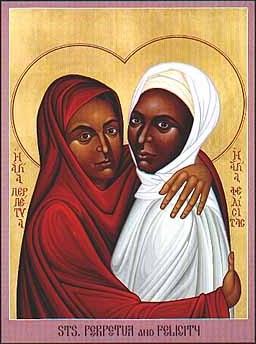
Before her death, St. Perpetua wrote an account of her sufferings, which we still have today. Obviously, someone else stepped up and finished the story after her death, but nevertheless, her autobiographical description is one of the first documents we have written by a woman--making St. Perpetua one of the first female writers! Her story was so popular, in fact, that St. Augustine had to warn his parishioners against giving it the weight of Scripture!

St. Perpetua was born around AD 181, in Carthage, a city of North Africa. She was the daughter of a wealthy Roman nobleman, and was married to a soldier. At that time in the Roman Empire, slavery was still a common and acceptable practice, and being a rich noblewoman, Perpetua had slaves. One of them was Felicity. But because they were of similar ages, and had both recently been married, and since Perpetua had just given birth, and Felicity was pregnant, the similar events in their lives led them to develop a friendship that went beyond slave-master.

At this time, in the Roman Empire, the Emperor, Caesar Septimus Severus had proclaimed that Christianity was illegal, and that it was therefore illegal to convert to Christianity, or to proclaim and teach the Christian faith to non-Christians. Those who were already Christians, or born into Christian families, were excluded from the government's censure, unless they tried to convert others--but for those who converted, the penalty was often death. Despite this, the Christians continued to spread the Gospel, convinced of its truth and importance. That was how St. Felicity's husband came to hear about Jesus, and he began learning about the Christian faith from a priest, Father Saturus. Felicity's husband, Revocatus, convinced Felicity to come and learn as well, and she in turn persuaded Perpetua.

These three, with two others (Saturninus and Secundulus), attended catechism in secret from Father Saturus. However, before they could complete their instruction, and be baptised the following Easter, the Roman government found out about their religious instruction, and had the five catechumens, as well as their priest, arrested. The date for their trial would not come right away, though, and they languished in their dungeon for months--awaiting a suitable occasion: the birthday of the Emperor!

During their time in prison, Fr. Saturus would continue to teach them the Christian faith, and, when they were catechised enough, he took some of their drinking water, and baptised each of them, since it would be impossible for them to wait for the following Easter. During this time, Perpetua's father, who was a nobleman and thus had influence, was permitted to visit Perpetua. But far from bringing joy and relief to her, she writes that his visits only served to vex her further, since he, as a Pagan Roman, continually tried to convince Perpetua to abandon the Christian faith to save her life. He appealed to her reason, to her honour and to her family's honour--to not die so shameful a death. But most of all, he appealed to her mother's heart, for who would take care of her newborn baby? Perpetua knew that her son would be starving without her to feed him, since he hadn't been weaned yet. But on one of her father's visits, he brought her mother and also her brothers, one of whom himself was also secretly learning the Christian faith (though, obviously, he hadn't been caught yet), and he went to the Deacons of the Church in Carthage, who bribed the guards to let Perpetua's baby be brought to her. And so she was able to feed her son until her trial.

Furthermore, Perpetua's brother also asked her to pray to God, that maybe she'd be granted a vision that would indicate whether her current sufferings and imprisonment would lead to martyrdom. She agreed, and in fact did receive a vision. Here's her account:
I beheld a ladder of bronze, marvelously great, reaching up to heaven; and it was narrow, so that not more than one might go up at one time. And in the sides of the ladder were planted all manner of things of iron. There were swords there, spears, hooks, and knives; so that if any that went up took not good heed or looked not upward, he would be torn and his flesh cling to the iron. And there was right at the ladder's foot a serpent lying, marvelously great, which lay in wait for those that would go up, and frightened them that they might not go up. Now Saturus went up first (who afterwards had of his own free will given up himself for our -sakes, because it was he who had edified us; and when we were taken he had not been there). And he came to the ladder's head; and he turned and said: Perpetua, I await you; but see that serpent bite you not. And I said: it shall not hurt me, in the name of Jesus Christ. And from beneath the ladder, as though it feared me, it softly put forth its head; and as though I trod on the first step I trod on its head. And I went up, and I saw a very great space of garden, and in the midst a man sitting, white-headed, in shepherd's clothing, tall milking his sheep; and standing around in white were many thousands. And he raised his head and beheld me and said to me: Welcome, child. And he cried to me, and from the curd he had from the milk he gave me as it were a morsel; and I took it with joined hands and ate it up; and all that stood around said, Amen. And at the sound of that word I awoke, yet eating I know not what of sweet.

And at once I told my brother, and we knew it should be a passion; and we began to have no hope any longer in this world.
(Meaning, of course, that they placed all their hope in Heaven, not that they gave in to despair.)

The six Christians continued to pray with each other and encourage each other as the day approached, but St. Felicity grew more and more worried. You see, she was still pregnant, and was not due to give birth until after the date slated for execution. According to Roman law, a pregnant woman could not be tortured or executed until after she had given birth. St. Felicity was worried not so much about being tortured or executed for Christ's sake, but that she would not be able to be martyred along with her friends. It's often hard to do the right thing. That's especially the case when it comes to giving your life. But it's even harder when you have to do it alone. Felicity was worried that when her time came, without her friends' encouragement she would not find the strength within her to confess Christ.

The six prayed together about this, and although Felicity was only about eight months pregnant, a week before their trial, she gave birth to a healthy baby, who was arranged to be adopted by a Christian family. In this, God showed that He was still with them, and cared for them, even in that dark prison. His asking of them to lay down their lives was not a sign that God had abandoned these six brave Christians, but rather, that He had singled them out for greater honour!

The day before their martyrdom, the six were allowed to have whatever they desired as a "last meal". Unanimously, they chose to have bread and wine, which Fr. Saturus blessed, and so they celebrated the Mass together. When the day finally came for these six great saints to be martyred, they were led to the arena in Carthage, to be tried by the magistrate. Each in their turn were asked whether they would renounce Christ and sacrifice a goat to Caesar and worship him, and each in their turn refused, claimed to be Christian, and were sentenced to be thrown to the wild beasts.

When it came time for Perpetua to be tried, however, not only the magistrate, but also her own father, attempted to convince her to abandon the Church. Her father came forward, carrying her baby in his arms, and appealed again to Perpetua to recant and live, so that her baby wouldn't die of starvation, for lack of milk. But again, through God's grace, He made it so that the baby was already weaned before his time, and no longer needed his mother to live. Thus, Perpetua, with her friends, professed herself a Christian, and was sentenced to death.

While the men were sentenced to face off against leopards and bears, out of spite and mockery for their femininity, the court sentenced Perpetua and Felicity to be attacked by a cow (a symbol of motherhood, and a mockery of these two mothers). When the two courageous women were thrown into the arena, Perpetua's robe tore, and she took the time to tie it so that she would appear modest and decent, taking more care for her modesty than for her own wounds. She even tied back her hair, since messy, unkempt hair was a sign of mourning in her culture, and she didn't want anyone to think that she was sad at her fate, but courageous and confident in God. She turned to help up Felicity, and immediately was led off to the side of the arena to rejoin the men who had survived the beasts. When there, she asked them, "When are we going to face the cow?" Amazed, her friends said to her, "You already have! It's hurt you! Look at yourself!" Perpetua and Felicity had been blessed by God to have had an ecstatic encounter with him, so that they were spared the pain of the cow's attack. In fact, Perpetua had to be shown her own wounds before she would believe her friends!

Afterward, all of them were led out again, and sentenced to be killed by the sword. The courage of these martyrs, particularly of the women, touched the audience so much, that many of them became Christians, including the jailer of the martyrs. It was one of these converts who finished the account of Perpetua's and Felicity's martyrdom, so that others in future generations would hear about and be inspired by their courage and sacrifice. In the author's own words:
O most valiant and blessed martyrs! O truly called and elected unto the glory of Our Lord Jesus Christ! Which glory he that magnifies, honors and adores, ought to read these witnesses likewise, as being no less than the old, unto the Church's edification; that these new wonders also may testify that one and the same Holy Spirit works ever until now, and with Him God the Father Almighty, and His Son Jesus Christ Our Lord, to Whom is glory and power unending for ever and ever. Amen.
God bless.

Labels: , , , , , ,

Tuesday, November 07, 2006

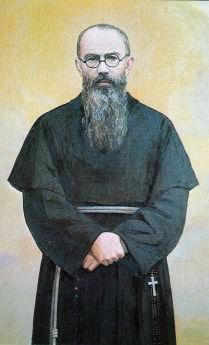
St. Maximilian Kolbe - 1941

Since Remembrance Day is coming up, I figured it would be good to relate the story of a Saint who played a large role in World War II.

Raymond Kolbe was born in 1894, in Zdunska Wola, Poland. Throughout his childhood, Raymond was quite a troublemaker. Very mischevious, he was always trying to get away with something, and his parents often considered him to be quite a trial. However, in 1906, around the time of his First Communion, things changed for Raymond. One night, he had a vision, and in that vision, he saw the Blessed Virgin Mary, and he asked her what was to become of his life. In response, she held out two crowns: one white, and the other red. The white one, she said, represented a life of purity, and the red one, a death of martyrdom. She told him he could choose a crown. Raymond decided to choose both.

Raymond chose to enter the priesthood with the Fransiscans, and took the name Maximilian. While in seminary, he and some friends started a club known as The Crusaders of Mary Immaculate, who were dedicated to spreading the Gospel of Jesus, the conversion of sinners, devotion to Mary, and to the Miraculous Medal.

After his ordination, St. Maximilian founded a Fransiscan monastery in Warsaw, Poland, in order to further spread faith in Christ and devotion to the Miraculous Medal, known as "The City of the Immaculate". After a while, though, he became restless, and felt God wanted him to travel as a missionary. So in 1930, Maximilian Kolbe went to Nagasaki, Japan, and there founded another monastery. After that, he continued on to India, doing the same thing, but illness caused him to have to return to Poland in 1936.

(Incidentally, Nagasaki was one of the two cities, with Hiroshima, that the USA dropped nuclear bombs on at the end of World War II, in retaliation for the Japanese attack of Pearl Harbour. The atomic bombs decimated nearly everything in those two cities--but, miraculously, St. Maximilian's monastery, and all those within, survived the bombing. Just one of the miracles attributed to devotion to the Miraculous Medal.)

Back in Poland, Maximilian continued his priestly duties, and overseeing the monastery there. On top of this, he began to publish and write for a newsletter called "The Knight". In it, he would teach about the love of Christ, and also address issues of justice and right living. When Adolph Hitler came to power in Germany in 1939, and began his Holocaust of the Jews and others who weren't of the Aryan race, many refugees began to flee from Germany to escape the oppression and persecution. Many of these refugees came to Poland, and Maximilian was able to put his teachings on love and justice into action, by hiding refugees in his monastery, and caring for them there. At one point, he had about 3000 refugees hidden in the monastery, and at least two-thirds of them were Jewish, because he knew that God loves all people, not just those of a certain ethnicity or religion.

For this act of hiding refugees, and for continuing publication of The Knight, which the Nazi Party considered to be Anti-Nazi, when Germany invaded Poland at the beginning of the War, Maximilian Kolbe was arrested and put into the Polish prison of Pawiak, on February 17, 1941. On May 28th, he was transferred to the Auschwitz concentration camp, in Germany, and even then was put in the worst sector--with particularly cruel guards--because he was a priest. There he was often beaten and deprived of food. Through it all, though, he continued to tell others about Christ, and to hear Confessions. He even, when he could get his hands on some smuggled in bread and wine, would say Mass and give other inmates the Eucharist!

After about a month and a half, there was an escape from Auschwitz. Protocol dictated that for every escaped prisoner, ten others were to be executed in his place. So the Nazis rounded up several people. One of them was a Jewish man named Franciszek Gajowniczek. He cried out, "Please! I have a wife and four children! Please don't kill me!" The guards were pitiless to his cries, but St. Maximilian Kolbe stepped forward and said, "This man has a wife and family. I am a priest. I have no wife, no children. Kill me instead and let this man go free."

In making this sacrifice, Maximilian lived out the two crowns that Our Lady had offered him: the purity of the priesthood, and the martyrdom of charity. He died on August 14th, 1941. Franciszek Gajowniczek did survive Auschwitz, and because of Maximilian's sacrifice, he and his family converted to Catholicism!
No one in the world can change Truth. What we can do and should do is to seek truth and to serve it when we have found it. The real conflict is the inner conflict. Beyond armies of occupation and the hecatombs of extermination camps, there are two irreconcilable enemies in the depth of every soul: good and evil, sin and love. And what use are the victories on the battlefield if we ourselves are defeated in our innermost personal selves?

Saint Maximilian Kolbe in the last issue of The Knight

Labels: , , , , , , , ,

Wednesday, November 01, 2006

St. Maria Goretti - 1902

St. Maria Goretti is unique among the saints and martyrs of the Catholic Church, as the youngest saint ever to be canonised! At the time of her martyrdom, she was only eleven and a half years old.

Maria Goretti was born on October 16, 1890, to a very large, but poor, Italian family. Her family was so poor, in fact, that in order to make ends meet, her father, Luigi Goretti, had to make arrangements with another family, the Serenellis, to come and live on their farm, and do the farmwork with them, in order to make ends meet--to have enough food and a place to live!

As Maria grew up, she made a decision to live as God would want her to--to be good, and humble, and modest. She would take care of her younger siblings, and do thankless chores around the farm, even when no one asked. Around town, she was well-known for her good behaviour and her modesty. When, two years after they'd moved to the Serenelli farm, her father died of Malaria, St. Maria Goretti had to mature even more, and continued to serve her family and take care of her brothers and sisters.

When she was growing up, Catholic children received the Sacraments of Confirmation and Holy Communion in a different order than we do today. Maria would have been Confirmed around the age of six or seven, and would not receive the Eucharist until she was eleven. As her opportunity for First Communion approached, Maria took extra care to prepare herself to receive such an awesome gift: Jesus Christ, fully present, Body, Blood, Soul, and Divinity, in the Eucharistic bread and wine! She spent much time in prayer and spiritual reading, in order to make sure she was worthy of receiving such a precious gift! When the day came, her family said that it was the greatest moment, and highlight of her life!

But if St. Maria Goretti could be considered a model of saintly virtue, of love, compassion, and modesty, then another person on that farm was the exact opposite. The Serenelli family had a son, Alessandro. And Alessandro was not a good kid. In his teens, he got into the wrong crowd, and going with them to parties and other things, he lived a very wayward life. Alessandro was often violent, and got in trouble with the law on more than one occasion. On top of all this, he would occupy his free time reading and looking at very impure things, like pornography. All of these choices that Alessandro made, caused him to have a very skewed and troubled, and selfish, outlook on life. And when he looked at Maria as she grew up, he felt lust in his heart.

Alessandro would many times try to come on to Maria, trying to seduce her; but Maria, very conscious of God's instructions on the topic of sex, and very protective of her modesty and purity, would tell Alessandro, No, and remind him that God did not permit that kind of behaviour. But Alessandro wasn't interested in what God wanted, but only what he wanted. Over and over, he would try to tempt Maria, and over and over she would turn him down, reminding him of God's Laws. Finally, Alessandro wasn't going to take no for an answer any more, and on July 5th, 1902, he tried to force himself on Maria, in order to rape her. When she again struggled to resist him, telling him again that "This is a sin! God doesn't want this! You can go to hell for this, Alessandro!" he took a knife, and stabbed Maria with it fourteen times. Maria was quickly taken to the hospital, and Alessandro was taken to prison.

As Maria lay in the hospital overnight from July 5th to 6th, 1902, she held a medal of Our Lady, and a Crucifix. Over and over, she prayed for Alessandro, that God would have mercy on him! She kept praying for Alessandro's forgiveness until she died, and, truly, even afterward in Heaven.

Meanwhile, Alessandro, who was a minor when he committed his attack, was sentenced to 30 years in prison. While there, nothing changed, and he continued to be a selfish, violent prisoner. Often he would attack the guards, as well as other inmates. He would even attack the faithful priest who would come to visit him, in order to encourage him to repent and turn to God. This behaviour continued for thirteen years.

But one night, Alessandro had a vision. In that vision, he saw Maria Goretti in a field full of lilies--a flower that has traditionally symbolised purity. Maria was gathering up the lilies into a bouquet, and then walked up to Alessandro. She told him to take the lilies, and when he did, he said they turned into a still white flame that went into his heart. Alessandro awoke from that vision as a changed person.

The next day, when the priest came to see him--probably expecting to be beaten up--he found a calm and quiet Alessandro Serenelli. That day, Alessandro made a good Confession, and turned his life over to Jesus Christ. After he served out the rest of his sentence, Alessandro went to Maria's mother, and asked her forgiveness for his crime. Mrs. Goretti forgave Alessandro, and that year they attended Christmas Eve mass together. Alessandro afterwards became a Capuchin monk, and lived a life of purity, helping others to turn from their sinful lifestyles.

When the cause of Maria's beatification came up, Alessandro Serenelli testified to her life and purity, and told of his crimes against her. When in 1952, Pope Pius XII canonised her as a saint, her mother was there to witness it! On that occasion, the Pope said these words:
With splendid courage she surrendered herself to God and his grace and so gave her life to protect her virginity.

The life of a simple girl - I shall concern myself only with highlights - we can see as worthy of heaven. Even today people can look upon it with admiration and respect. Parents can learn from her story how to raise their God-given children in virtue, courage, and holiness; they can learn to train them in the Catholic faith so that, when put to the test, God's grace will support them and they will come through undefeated, unscathed, and untarnished.

From Maria's story carefree children and young people with their zest for life can learn not to be led astray by attractive pleasures which are not only ephemeral and empty but also sinful. Instead they can fix their sights on achieving Christian moral perfection, however difficult that course may prove. With determination and God's help all of us can attain that goal by persistent effort and prayer.

Not all of us are expected to die a martyr's death, but we are all called to the pursuit of Christian virtue.

So let us all, with God's grace, strive to reach the goal that the example of the virgin martyr, Saint Maria Goretti, sets before us. Through her prayers to the Redeemer may all of us, each in his own way, joyfully try to follow the inspiring example of Maria Goretti who now enjoys eternal happiness in heaven.
St. Maria Goretti again reminds us that the story of a martyr goes beyond their tragic death--but always impacts the lives around them, even their killers, as we see from the radical change Maria's example of purity, her willingness to die, and her prayers from heaven had on Alessandro Serenelli.

God bless.

Labels: , , , , , , , ,

Tuesday, October 10, 2006

Sr. Leonella - 2006 (Sept. 17)

In the last post, I wrote about St. Stephen, the first Christian martyr. This post, we'll be skipping forward to very nearly the latest Christian martyr! She's not on my Get Holy or Die Tryin' t-shirt. She was still alive when it was made! In fact, Sr. Leonella only joined the ranks of martyrs a short three weeks ago, though she seemed to expect it for many years.

Thirty-eight years ago, Sister Leonella decided to consecrate her life to God, and become a nun. She made her perpetual vows and joined the Order of the Sisters of Consolation, and went to Kenya to work in a hospital among the poor and suffering just outside of Kenya's capital, Nairobi. Her infectious enthusiasm and love for her patients and all she met earned her great love and respect in her community. After working there for many years, her fellow sisters even elected her to Regional Superior at the hospital, which she did for 6 years! While she was in that position, she trained new sisters for the work of loving and caring for the poor, and trained them to be nurses in the hospital. During this time, she was able to get the World Heath Organisation to recognise the sisters in her order as validly certified nurses!

After 6 years, in 2001 she took a sabbatical, and travelled to Mogadishu, Somalia, to investigate starting a hospital there through the SOS Village organisation. Her vision became a reality the next year, and she was also in charge of the nursing school there.

In going to Somalia, ravaged by civil war for over 15 years, and still now in a state of uneasy peace and civil unrest, with an Al-Qaida cell vying for political power, Sr. Leonella knew the risks she faced as a Catholic nun. She would often joke, even back in Kenya, that one day there would be a bullet with her name on it. But the risk didn't deter her. Neither did her often poor health or the struggles with governments and bureaucracies. Through it all, she continued to work for and to love the people of Africa. But she wasn't naively unaware of the risks, either. One of her sisters had been kidnapped in the previous year. She was found and her kidnapper sentenced to one year, but this and other attacks and threats to their lives prompted Sr. Leonella to hire a bodyguard to protect her.

On September 17th, 2006, after making the rounds of the hospital she helped begin in Mogadishu, she and her bodyguard were crossing the street 30 feet to her home, where five of her sisters were waiting to have lunch. As she and her bodyguard crossed the street, three gunmen, lying in wait, shot her, killing her and her bodyguard execution-style. When her sisters heard the shots, they ran out of the home to see what was going on. As the gunmen fled, the sisters carried Sr. Leonella and her bodyguard back into the hospital, but it was too late. As Sr. Leonella lay dying, she kept repeating "Pardono, pardono, pardono..." which is Italian for "Forgive, forgive, forgive..." Just like St. Stephen, Sr. Leonella prayed to forgive her enemies, and, at the same time, instructed her fellow sisters, and everyone else around, that they must forgive her killers, too, and not become bitter and hateful.

At her funeral, the Bishop remarked on her life and on her love. He also remarked on the circumstances of her death, and her dying with her bodyguard. He said that if a man and a woman could die together; a black man and a white woman; a Muslim man and a Catholic nun, could die together, then it was a sign of hope that we could live together, in peace.

That's the vision that Sr. Leonella had for Somalia. And through her love, she lived out that vision daily. Pope Benedict XVI echoed Tertullian, when he expressed his prayer that "the blood shed by so faithful a disciple of the Gospel may become a seed of hope to construct authentic brotherhood among peoples."

Many in the news speculated that Sr. Leonella was murdered as a reaction to the Pope's remarks made in a lecture last month about how violence is incompatible with the nature of God, and cited Islam as an example of spreading the faith by the sword. It prompted many protests from Muslims throughout the world, but in Sr. Leonella's case, let's remember again, that she'd already been threatened, and a fellow sister had even been kidnapped, before the Pope had ever made his speech. She didn't have a bodyguard for nothing!

Let us remember Sr. Leonella's legacy of love and forgiveness, and her inspiring courage in the face of many tremendous obstacles! Let us be full of courage in our own lives, as we reach out to help others with the love of God.

Amen.

Labels: , , , ,

Wednesday, October 04, 2006

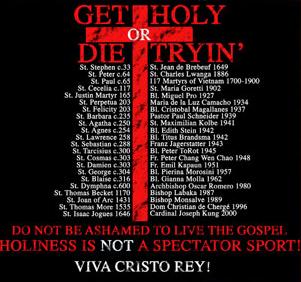
Get Holy or Die Tryin'


I realise that I typically use red to denote the words of Christ from Scripture. However, liturgically, red is the colour worn by the priests on feasts in honour of the Martyrs. Over the school year, when a title on this blog is in red, the post will be telling the story of one such martyr.

Last summer, I went down to the Franciscan University of Steubenville's annual youth conference (which rocked out loud, and we'll be going as a youth group next year!), and while I was there, I explored the gift shop and found the t-shirt pictured above, made by Catholic to the Max.com. I saw it, and had to get it, mainly because St. Jean de Brébeuf topped the second column, and, being a Canadian martyr, my patriotism swayed my decision against other very cool t-shirts. At the time that I bought the shirt, I did not realise that it was, in fact, a parody of 50 Cent: Get Rich or Die Tryin'. I just thought that it was a wicked shirt, with martyrs on the back, and a slogan that we as Catholics should all aspire to: Get Holy, or Die Tryin'.

Now that the school year is back in full swing, and I'm back visiting the elementary schools' senior grades, I've decided, instead of just preachin' at them, to tell stories instead--and the stories I have to tell are those of the martyrs (particularly those on the back of my t-shirt, listed above). Now, there are 44 listings on the shirt, and less than 44 weeks in the school year, so we won't cover all of them. But I will select the ones that I think have the most captivating, inspiring, and challenging tales (a difficult task, in light of the roster--but then, I feel I can be choosy, since the creators of the shirt themselves were choosy. If they included all the martyrs, the t-shirt would need to be a robe, covered front and back with their names!).

The fact that the t-shirt is a parody of 50 Cent's misguided motto adds further depth to the message. 50 Cent reflects the world's view of success: to be rich, successful, famous, and all that. In stark contrast, Jesus in the Beatitudes reminds us that it is the poor, gentle, mournful, hungry and thirsty for righteousness, merciful, pure in heart, peacemakers, and persecuted who are blessed and truly successful.

In the lives of the martyrs that we'll hear about, we will see all of these characteristics lived out as the Spirit of God makes these normal men and women, just like us, able.

While the world would look at a person who gives up their entire life in service of Christ, and is willing to even suffer persecution and death for that, as a fool and a failure, the Catholic Church views these people as Heroes to be looked up to and emulated. These are the Church's greatest success stories, and their impact on this world far surpasses their deaths. The ancient Christian writer Tertullian once remarked that the blood of the martyrs is the seed of the Church. Throughout history, and in our modern world, it is where Christians are persecuted that the Church is strongest and growing fastest.

The examples of the martyrs' lives on earth, and their prayers for the world, in heaven, continue to change the world we live in, in extraordinary ways. May we, filled with the Spirit of God, lead lives such as theirs.

As many a martyr said upon his death:
Long Live Christ the King!

Labels: , , ,

Thursday, December 15, 2005

Jesus Freaks

Quick question: Who wants to be a saint?
The Catechism of the Catholic Church describes a saint as someone who "practiced heroic virtue and lived in fidelity to God's grace" (paragraph 828). In other words, in order to become a saint, you gotta be a freak!
Jesus Freak
DC Talk

Separated, I cut myself clean
From a past that comes back in my darkest of dreams
Been apprehended by a spiritual force
And a grace that replaced all the me I've divorced

Saw a man with a tat on his big fat belly
It wriggled around like marmalade jelly
It took me a while to catch what it said
'Cause I had to match the rhythm
Of his belly with my head
'Jesus Saves' is what it raved in a typical tattoo green
He stood on a box in the middle of the city
And claimed he had a dream...

What will people think when they hear that I'm a Jesus Freak?
What will people do if they find out it's true?
I don't really care if they label me a Jesus Freak
There ain't no disguising the truth!


Kamikaze, my death is gain
I've been marked by my Maker, a peculiar display
The high and lofty, they see me as weak
'Cause I won't live and die for the power they seek

There was a man from the desert with maps in his head
The sand that he walked was also his bed
The words that he spoke made the people assume
There wasn't too much left in the Upper Room
With skins on his back and hair on his face
They thought he was strange by the locusts he ate
Y'see the Pharisees tripped when they heard him speak
'Til the king took the head of this Jesus Freak

What will people think when they hear that I'm a Jesus Freak?
What will people do if they find out it's true?
I don't really care if they label me a Jesus Freak
There ain't no disguising the truth!


People think I'm strange; does it make me a stranger
That my Best Friend was born in a manger?
People think I'm strange; does it make me a stranger
That my Best Friend was born in a manger?

What will people think when they hear that I'm a Jesus Freak?
What will people do if they find out it's true?
I don't really care if they label me a Jesus Freak
There ain't no disguising the truth!


What will people think [What will people think]?
What will people do [What will people do]?
I don't really care [What else can I say?]
There ain’t no disguising the truth [Jesus is the Way!]
All of the thousands of saints have this one thing in common: They were freaks! They were not normal in the eyes of the world! Think about it: the guy that the song talks about in the second verse--Here's a guy who lives in the desert, in camel skin, on a diet of locusts and honey, telling people that the Messiah is coming and they need to repent. The authorities didn't like that so much, and he got his head chopped off! Now we know him as Saint John the Baptist.

Or how about St. Francis of Assisi? Here's a rich kid, very popular, going to all the parties and hangin' with his friends--until one day he gets sick on the way to the Crusades, comes home, and while he's recovering he hears God speak to him! From that point on, he gives up all his wealth, his status, even his family name! He goes around begging for his food and preaching the Gospel, helping lepers, and even goes to the Crusades--not to fight, but to preach to the Muslims! People thought he was a fool; people thought he was crazy; people thought he was a freak. We think of him as a saint.

What about Joan of Arc? This is a girl in her early teens, who starts hearing voices, and listens to them! She dresses like a boy, joins the French army, and leads it to victory (despite whatever French jokes you may have heard)! Well, the English, those people whom Joan's conquests beat down, didn't like that so much, so they captured her, put her on a mock trial on trumped up charges, and still she didn't deny her faith. She was burned at the stake for serving God, and now we call her Saint Joan of Arc!

I could go on and on about people who have lived lives so radically, freakishly devoted to Christ, but one more example will suffice. We all remember Blessed Mother Teresa. She's not a saint, yet, but she will be! She was a woman who was called by God to go to India, where Hinduism has set up a caste system. On the bottom of the castes are the "dalit", or the untouchables. These are the poorest of the poor, and you don't talk to them, or feed them, or touch them. You don't acknowledge them at all! Unless, that is, you are a Christian--specifically, a small, in-your-face woman named Mother Teresa! She left everything that she had behind and went to India to minister to these people. Why? Because in their suffering faces, she saw the suffering Face of Christ!

The Bible talks about people like these. In Hebrews chapter 11, it talks about the Old Testament Saints, commending their faith and devotion. The chapter concludes with these words:
These were men who through faith conquered kingdoms, did what was upright and earned the promises. They could keep a lion's mouth shut, put out blazing fires and emerge unscathed from battle. They were weak people who were given strength to be brave in war and drive back foreign invaders. Some returned to their wives from the dead by resurrection; and others submitted to torture, refusing release so that they would rise again to a better life. Some had to bear being pilloried and flogged, or even chained up in prison. They were stoned, or sawn in half, or killed by the sword; they were homeless, and wore only the skins of sheep and goats; they were in want and hardship, and maltreated. They were too good for the world and they wandered in deserts and mountains and in caves and ravines.
Chapter 12 begins by bringing their example home to us:
With so many witnesses in a great cloud all around us, we too, then, should throw off everything that weighs us down and the sin that clings so closely, and with perseverance keep running the race which lies ahead of us. Let us keep our eyes fixed on Jesus, who leads us in our faith and brings it to perfection: for the sake of the joy which lay ahead of Him, He endured the cross, disregarding the shame of it, and has taken His seat at the right of God's throne. Think of the way He persevered against such opposition from sinners and then you will not lose heart and come to grief. In the fight against sin, you have not yet had to keep fighting to the point of bloodshed.
We must be willing to follow Christ, even if that means that we have to sacrifice our coolness, or our popularity, or even our wealth. We must be willing to stick with Him, even if it costs us our freedom, or even our very lives. We must be willing to be Jesus Freaks.
The bridge of the song asks us,
People think I'm strange; does it make me a stranger
That my Best Friend was born in a manger?
First of all, is Jesus your best friend? If you can't honestly answer "yes" to that question, then something needs to change in your heart. Jesus said that He no longer calls us "servants", but "friends" (John 15:15), but right before that, He says that His friends do whatever He tells them (v. 14). Are you willing to do that? Are you willing to be a stranger for the One who was born in a Manger?

Have a freakish Christmas!
God bless!

Labels: , , , ,

Friday, August 26, 2005

The Seven Deadlies

I apologise for the lack of posting new talks recently. The popularity of the Open Q&A (below) caught me quite by surprise. But at 180 comments, it seems to have petered out. Though, I would point out, that it is still open! For now, I'd like to catch up on a talk we had a few weeks ago, on sin.

Since the Fall of our first parents, Adam and Eve, all of us have been born with what's called a "sinful nature". Basically, while Adam and Eve were created perfect by God, completely holy and just, their decision to sin affected their nature in such a way that that holiness and justice was destroyed in them. Because of that, they became subjected to ignorance, suffering, sin, and death. We kind of inherited that state. Our natures are wounded, and we are born with the desire to be sinful and with our hearts turned away from God.

Before our baptisms, we were completely alienated from God. We were outside of His family. But through baptism, and our faith and repentance, we enter into a life-giving relationship with God, and He fills us with His grace--the grace to live that life of holiness and justice that Adam and Eve lost. But our baptism didn't completely erase the consequences of sin. We still suffer and die. Our minds are still subject to ignorance, and we still have that pesky urge to sin. We are often tempted, and we constantly struggle.

So what is sin? It is an action (or lack of action) that violates God's law. At its heart, it is a rebellion against God, which says, "I know better", or "I don't care." Or, more famously expressed by Frank Sinatra, "I did it my way!"

There are degrees of sin, which the Church has labelled "mortal" and "venial" sins (1 John 5:16-17). A venial sin is one that only wounds our relationship with Christ, but does not kill it outright. We don't exclude ourselves from His Covenant with us. Mortal sins on the other hand, are just that: Mortal. They kill the life of grace within us. According to the Catechism of the Catholic Church, Mortal sin "destroys charity in the heart of man by a grave violation of God's law; it turns man away from God, who is his ultimate end and his beatitude, by preferring an inferior good to Him" (1855).

For a sin to be mortal, three conditions must be met: It must be a grave matter, committed with full knowledge and deliberate consent.
1858 Grave matter is specified by the Ten Commandments, corresponding to the answer of Jesus to the rich young man: "Do not kill, Do not commit adultery, Do not steal, Do not bear false witness, Do not defraud, Honour your father and your mother." [Mk 10:19] The gravity of sins is more or less great: murder is graver than theft. One must also take into account who is wronged: violence against parents is in itself graver than violence against a stranger.

1859 Mortal sin requires full knowledge and complete consent. It presupposes knowledge of the sinful character of the act, of its opposition to God's law. It also implies a consent sufficiently deliberate to be a personal choice. Feigned ignorance and hardness of heart [Cf. Mk 3:5-6; Lk 16:19-31] do not diminish, but rather increase, the voluntary character of a sin.


Venial sins can become mortal if we persist in them, and make a habit of them.

A further distinction in sin is known as the Capital sins, or more familiarly as the Seven Deadly Sins. These are "capital [head] sins" because they are the root or the cause of all other sins. They are Pride, Avarice (Greed), Envy, Wrath (Anger), Lust, Gluttony, and Sloth.

These are the sins in our lives that we need to watch for, because they are the causes of other sin in your life. If you constantly struggle with certain actions, and no matter how much you try to change them, then you need to look deeper. Sin is like a weed. You can pull the weed up, grabbing the stalk, leaves and flower, so that it is no longer visible--but if you do not grab the root, the weed will grow back. It is the same with these deadly sins.

Before we look in detail at the sins, a few thoughts, from a website about the deadly sins might be useful.

"The following pages on the deadly sins may lead to horrible discoveries. Bear in mind:
1. Friends will almost never volunteer this information.
2. If they do, we will not accept it.
3. God forgives anything, even repeatedly, so do not be afraid."

"If one or more of these doesn't seem like a big sin to you, it almost certainly means you have already rationalised it. Work on that one first."

How do we work on these sins? Through discipline, spiritual reading (especially Scripture), frequent prayer, Mass, Confession, and the practice of Christian virtues in our lives. So let us examine each sin, what it is exactly, and what virtue(s) we should foster in order to counter and defeat it.

Pride: If any sin could be considered "the deadliest", this is it. It is the very sin that got Lucifer kicked out of heaven, and the very sin that he used to tempt Adam and Eve. Basically, pride is the notion that "I deserve better." It is the desire to be the master of our own destiny. It says, basically, that I should be my own god. Is it any wonder then, that "God resists the proud, but gives grace to the humble" (James 4:6; 1 Peter 5:5)?

As those verses point out, Humility is the key virtue in the fight against pride. Humility is seeing ourselves as we truly are, and not comparing ourselves with others. It is the willingness to accept criticism and grow from it, to realise that we really aren't the be all and end all of the universe. It is ultimately being open to God's leading and direction, and a willingness to follow and to serve Him.

Greed or Avarice: The vice of Greed is about more than money. Similar to pride, it is the desire to be the centre, to "get what we deserve" and maybe a little more. It is the desire to hold tightly to what we have, because "it's mine!" In a non-monetary way (though it often becomes about money) people who speak of their "rights" are often being greedy. Lawsuits over rights issues involve large cash settlements in our society.

By contrast, then, Generosity is a virtue that we need. After all, "God loves a cheerful giver" (2 Corinthians 9:7). The angel Raphael reminds us, "Prayer with fasting and alms with uprightness are better than riches with iniquity. Better to practise almsgiving than to hoard up gold. Almsgiving saves from death and purges every kind of sin. Those who give alms have their fill of days; those who commit sin and do evil bring harm on themselves" (Tobit 12:8-10).

Envy: Envy resents the good others receive or even might receive. In this sense, it is almost indistinguishable from pride at times. Pride is inwardly working, drawing the attention toward ourselves. Envy is outwardly focussed. It obsesses about attention given to others. In that way, they are like two sides of the same sin. Envy is desiring something for ourselves that does not rightfully belong to us. It is "coveting" (the tenth commandment).

As a note: It is distinct from "Jealousy" in that envy desires to gain something not rightfully belonging to the person, whereas jealousy seeks to retain hold of something that does belong to the person. Thus, envy is always sinful, while jealousy can become sinful, but is not inherently so. This is why God can be called a "jealous" God, and still be holy and righteous in prohibiting envy among His people. Many people misunderstand the difference.

Against envy we must Love. Love is always outward focussed. It seeks the best in others, and works for their good. While the virtue of love is effective in nullifying all the vices (which is why it is the greatest of the virtues) it specifically speaks to envy, and to pride, demanding that we take the focus off ourselves and direct it to others.

Anger or Wrath: Living with bitterness and unforgiveness, quickly flying off the handle at the slightest provocation, waving at other drivers with only one finger...These are symptoms of anger. While anger is usually a reactionary issue, it can become a deep-seated habit, leading to lovelessness and abusive behaviour. When anger becomes a behavioural trait, it ceases to be a simple emotional response, and becomes sinful. While there is an anger that is good, a "righteous anger" directed at sin and injustice, truly seeing or experiencing such noble anger is rare.

Its antidote is Kindness. It means taking the tender approach, being patient and compassionate. It seeks to understand and forgive the other person, to give them the benefit of the doubt.

Lust: This is something usually associated with sex, but it is not limited to that. Lust is the out of control desire for pleasure, beyond what it is worth. That pleasure might be sexual, or power, or image. But when it becomes our focus, our desire, then it is out of control. Image, power, and sex are good things when in their proper place and understood with their proper value--but when they are sought for their own sake, it is sin.

The virtues opposed to lust are Love and self-control. Lust is a selfish desire for pleasure. Love seeks the good of others above self. It is able to weild the good things that lust seeks, but does so for the good of others. Self-control maintains the balance between pleasure and over-indulgence. It keeps the true value of true riches in sight, and does not elevate pleasure beyond its worth.

Gluttony: Like lust goes beyond sex, gluttony goes beyond food. It is the undue desire for pleasure more in the realm of leisure and entertainment, whether it be through food, other forms of entertainment such as television, or even the company of others.

It is battled by Faith and temperance. Temperance accepts the natural limits of pleasures and preserves this natural balance. Faith or faithfulness, keeps us focussed on what is truly important.

Sloth: Laziness affects us both physically and spiritually--and often, if one is lax in one area, the same is true in the other area. Disorganisation, forgetfulness, and a lack of dependability are symptoms of sloth. As well, failure to be diligent in your spiritual walk, not praying, sleeping through church, failure to read the Bible and other spiritual reading are indications that sloth has affected our spiritual life. Sloth is more subtle than some of the others, because we don't notice it right away. Rationalising away spiritual exercises begins by saying, "God won't mind if I skip it once" and ends up being a great effort to read or pray or in any way draw closer to Christ.

We must counter sloth with Zeal. Zeal is the energetic response of the heart to God's commands. It is the quickening of our spirit to follow hard after Him. Like the disciples in the Garden of Gethsemane, we must watch and pray, so that we do not fall asleep in service to Christ. With zeal, we must maintain discipline, so that habits will form. Habitually meeting with God will enflame our zeal, and our zeal will reinforce our habits.

These sins conspire together to deaden our spiritual life. Because of the nature of mortal sin, a new initiative of God's mercy is needed, as well as a conversion of our hearts. This is accomplished through the sacrament of Penance. Basically, because in mortal sin, we've flipped God off, and left the Covenant relationship with Him, killing His life of grace in our hearts, we need to receive that grace again from Him to be welcomed back into the Covenant. Through the sacrament of Reconciliation, we demonstrate our sincere repentance by confession (1 John 1:9; James 5:14-16), which is followed by an act of penance, which is our actions that reorient, or redirect, ourselves to God. Repentance is literally a 180 degree U-turn from living in sin to living for God. The penance that we are given to do in the sacrament is the means to point us in the right way, and the first steps on the road back to God.

The penance should be offered to God for the forgiveness of sins, but also for the grace to live out and develop the virtues that He gives us. The virtues are not things that we can muster up on our own, but themselves are gifts from Jesus Christ. We must be open to receiving them and living in them. We must stay close to their source, to Jesus.

Amen.

Labels: , ,